
When Taiwanese Poets Wrote for Ukraine
Author:Oleksandr Shyn|Chief Editor of the Ukrainian Service at Radio Taiwan International (Rti).
When confronted by geopolitical forces so much greater than our own, what use do we have for literature?”, Yang Shuang-zi asked while holding in her hands the first Booker Prize awarded to Taiwan.
A few days before Yang Shuang-zi and Lin King went on stage in London earlier this year, I found myself moderating an event in Taipei. On the surface, it seemed a cosy affair: three Taiwanese poets reading their poems about Ukraine to an audience largely made up of visiting Ukrainian journalists.
But the question lingered in the room. What use does literature, for poetry for that matter, have in the face of constant Russian aerial attacks, occupation and war?
“Literature appears slow”, Yang said . “But it acts with steady resolve.” The history of Ukraine proves it.
The poetry reading took place in May as part of a week-long programme hosted by the Asia-Pacific bureau of Reporters Without Borders (RSF) and curated by FactLink and Chris Liu, Vice President of Radio Taiwan International (RTI).The programme brought eleven Ukrainian journalists, alongside several colleagues from other Eastern and Central European countries, to Taiwan for discussions on media resilience and the challenges faced by democratic societies under pressure.
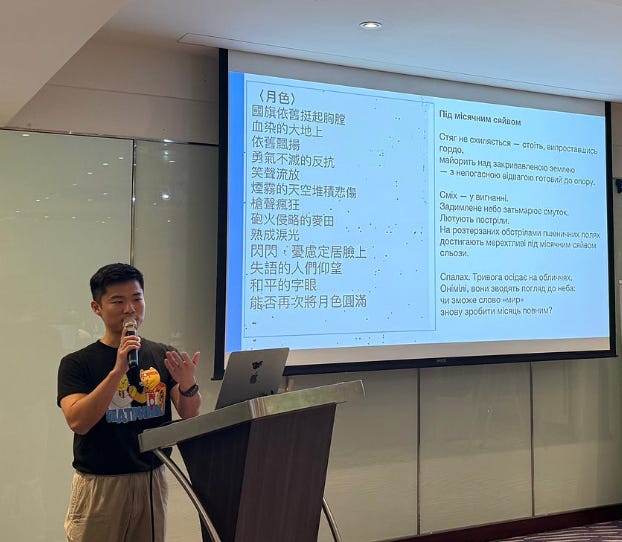
Most sessions focused on journalism, security and disinformation. But one of the lighter entries on the programme was a poetry reading.
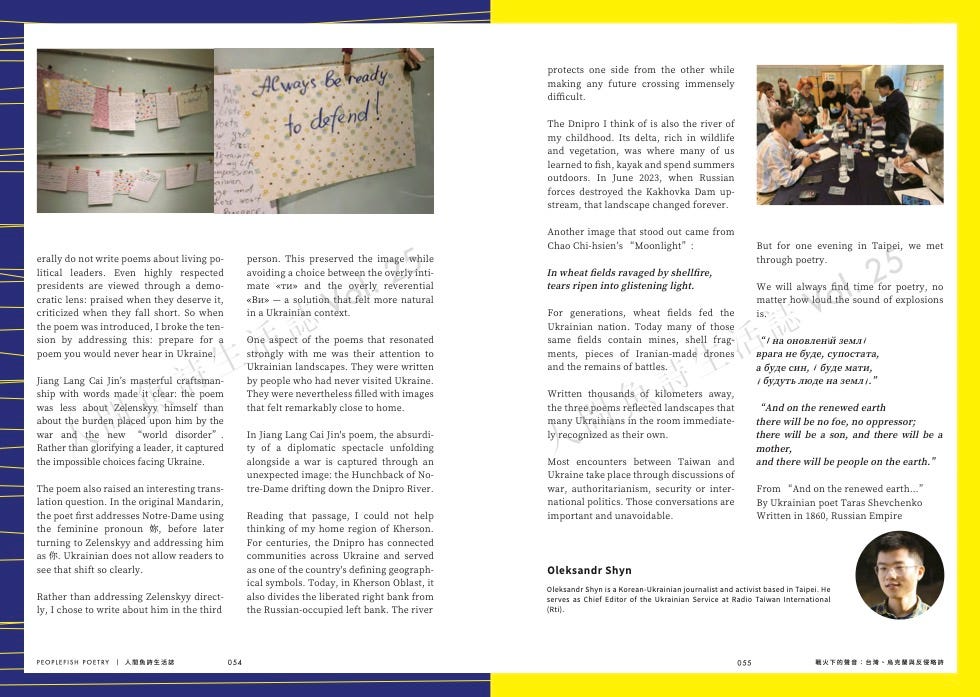
Following Russia’s full-scale invasion of Ukraine, Peoplefish Poetry & Life Magazine published special editions featuring poems written by ordinary Taiwanese citizens reflecting on the war and the Ukrainian people’s resistance. Three of those poets were invited to share their work during the event: Jiang Lang Cai Jin, Mason Chen, and Chao Chi-hsien.
Each poem was first read aloud in Mandarin Chinese by its author. As a poetry lover myself, I translated the poems into Ukrainian, and a visiting journalist from Hromadske Radio Anastasiia Bahalika volunteered to read out the Ukrainian translations for us.
It was a small event that brought together people who, under ordinary circumstances, might never have met: Taiwanese poets, for whom poetry is a hobby and a way of observing the world, and Ukrainian journalists for whom war reporting has become a daily reality.
What I did not fully expect was the reaction the poems would receive from the Ukrainian journalists in the audience.
Some listeners grew visibly emotional. Afterwards, several approached the poets and asked them to sign copies of the magazine editions. Others came up to thank me for the translations and for particular choices of words in Ukrainian.
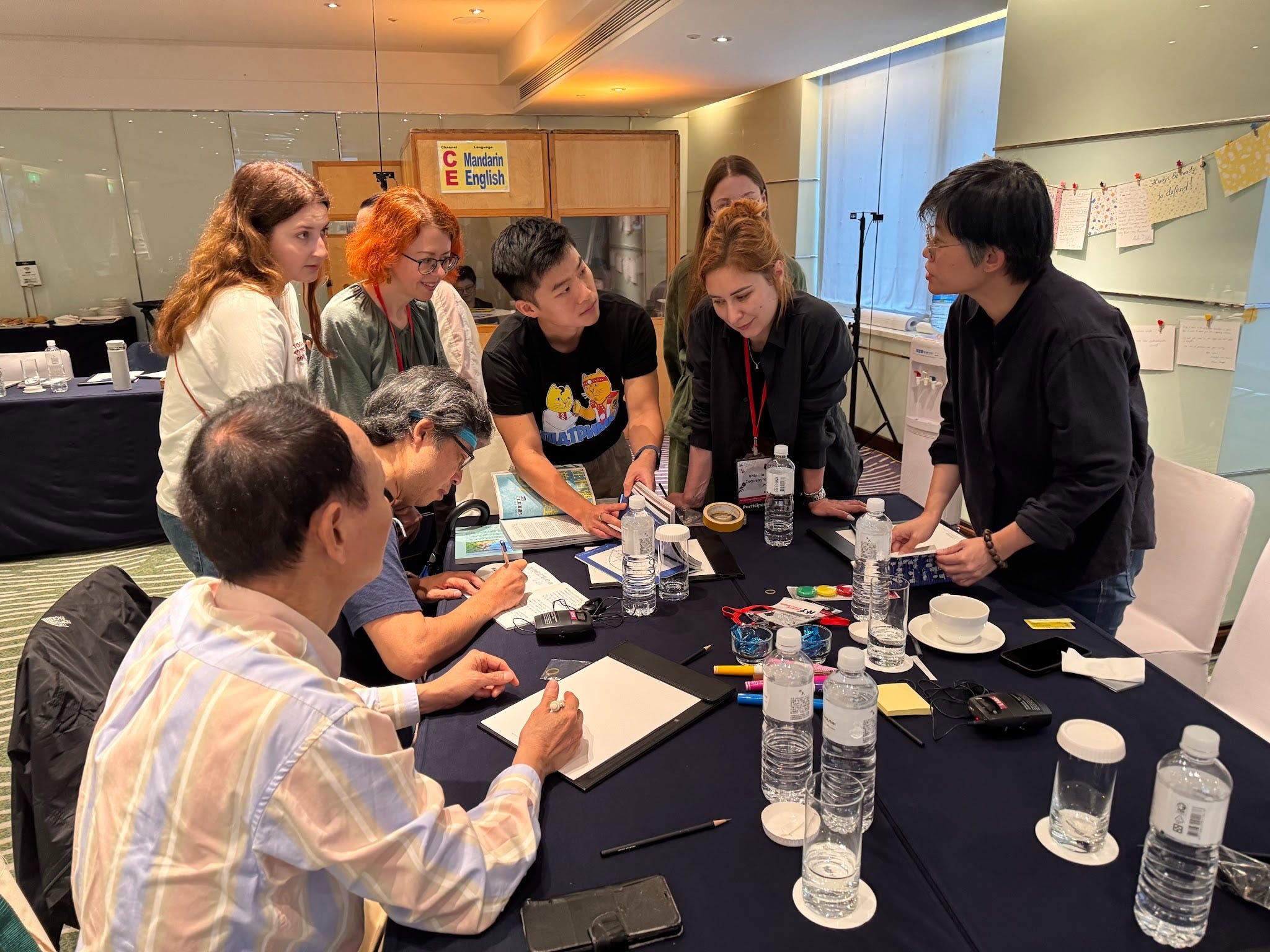
The reaction itself did not surprise me because Taiwanese support for Ukraine has been visible throughout the years I have lived in Taipei. But what felt truly rare was hearing people from a place as distant as Taiwan write poetry about Ukraine, and do so with such sincerity. That is because for me, poetry has always been one of the most intimate forms of writing, an ultimate openness one can have with themselves.
To understand why these poems resonated with the Ukrainians in the room, one has to understand the place poetry occupies in Ukrainian society.
Few countries illustrate Yang Shuang-zi’s idea better than Ukraine. For centuries, Ukrainian literature advanced under conditions that often made its very existence uncertain. It survived language prohibitions, censorship, imprisonment, exile and execution.
“自古以來,自古以來⋯⋯” Was one of the phrases that Mason Chen brought into the room through his poem “On Taiwan’s 228 Peace Memorial Day, We Remember Ukraine”. I chose to translate it into Ukrainian via a phrase frequently appears in Russian political discourse: «исторически так сложилось», or in English: “historically, it happened this way”.
“Ukrainians are Russians, because many in Ukraine speak Russian. Historically, it happened this way”, — they would declare and come with a war to assert their lunatic claim not just with words but with force.
But history does not simply happen this or that way.
The Ukrainian language was repeatedly restricted under the Russian Empire. The Valuev Circular of 1863 claimed that a separate Ukrainian language did not truly exist and restricted its publication. The Ems Decree of 1876 further limited Ukrainian-language books, theatre and education. In the Soviet era of Russia’s imperial control over Ukraine, generations of Ukrainian writers, artists and intellectuals were persecuted in what is now remembered as the Executed Renaissance. Kobzars — travelling bards who preserved Ukraine’s historical memory through song and poetry — were prosecuted. Even the letter Ґ, a distinctive part of the Ukrainian alphabet, disappeared from official orthography for decades — simply because our language had it, and theirs did not.
The purpose of these policies was not simply to regulate language but to reshape identity.
Today, Russia continues similar practices in the occupied territories of Ukraine. Ukrainian books are removed from libraries. Ukrainian-language education is curtailed. Teachers, journalists and cultural workers face targeted attacks, persecution or imprisonment. At the same time, Russian missiles and drones continue to strike schools, libraries and cultural institutions across the country.
To have preserved our language is an effort worth millions of medals and awards — for generations of Ukrainians who continued to write, sing, and proclaim despite persecution. Throughout Ukrainian history, poets and writers have often been among those who carried the language forward when political institutions could not, or were not allowed to.
And Ukrainians continue to write today, in their own language. Some write from exile, some from bomb shelters, and some while serving in the military.
The poet Lina Kostenko, who is often credited with preserving the Ukrainian lyric poetry, once wrote: “Nations do not die from heart attacks. First they lose their language.”
This is the slow power Yang Shuang-zi spoke about. Literature rarely stops a missile or liberates an occupied city. Over generations, however, it can preserve a language, a memory and a sense of belonging. In Ukraine’s case, it helped preserve a nation.
During the event in Taipei, the discussion soon moved from political references to another translation problem altogether.
The visible tension in the room came during Jiang Lang Cai Jin’s poem about Volodymyr Zelenskyy and the reopening of Notre-Dame de Paris. Ukrainians generally do not write poems about living political leaders. Even highly respected presidents are viewed through a democratic lens: praised when they deserve it, criticized when they fall short. So when the poem was introduced, I broke the tension by addressing this: prepare for a poem you would never hear in Ukraine.
Jiang Lang Cai Jin’s masterful craftsmanship with words made it clear: the poem was less about Zelenskyy himself than about the burden placed upon him by the war and the new “world disorder”. Rather than glorifying a leader, it captured the impossible choices facing Ukraine.
The poem also raised an interesting translation question. In the original Mandarin, the poet first addresses Notre-Dame using the feminine pronoun 妳, before later turning to Zelenskyy and addressing him as 你. Ukrainian does not allow readers to see that shift so clearly.
Rather than addressing Zelenskyy directly, I chose to write about him in the third person. This preserved the image while avoiding a choice between the overly intimate «ти» and the overly reverential «Ви» — a solution that felt more natural in a Ukrainian context.
One aspect of the poems that resonated strongly with me was their attention to Ukrainian landscapes. They were written by people who had never visited Ukraine. They were nevertheless filled with images that felt remarkably close to home.
In Jiang Lang Cai Jin’s poem, the absurdity of a diplomatic spectacle unfolding alongside a war is captured through an unexpected image: the Hunchback of Notre-Dame drifting down the Dnipro River.
Reading that passage, I could not help thinking of my home region of Kherson. For centuries, the Dnipro has connected communities across Ukraine and served as one of the country’s defining geographical symbols. Today, in Kherson Oblast, it also divides the liberated right bank from the Russian-occupied left bank. The river protects one side from the other while making any future crossing immensely difficult.
The Dnipro I think of is also the river of my childhood. Its delta, rich in wildlife and vegetation, was where many of us learned to fish, kayak and spend summers outdoors. In June 2023, when Russian forces destroyed the Kakhovka Dam upstream, that landscape changed forever.
Another image that stood out came from Chao Chi-hsien’s “Moonlight”:
“In wheat fields ravaged by shellfire,
tears ripen into glistening light.”
For generations, wheat fields fed the Ukrainian nation. Today many of those same fields contain mines, shell fragments, pieces of Iranian-made drones and the remains of battles.
Written thousands of kilometers away, the three poems reflected landscapes that many Ukrainians in the room immediately recognized as their own.
Most encounters between Taiwan and Ukraine take place through discussions of war, authoritarianism, security or international politics. Those conversations are important and unavoidable.
But for one evening in Taipei, we met through poetry.
We will always find time for poetry, no matter how loud the sound of explosions is.
“І на оновленій землі
врага не буде, супостата,
а буде син, і буде мати,
і будуть люде на землі.”
“And on the renewed earth
there will be no foe, no oppressor;
there will be a son, and there will be a mother,
and there will be people on the earth.”
From “And on the renewed earth…”
By Ukrainian poet Taras Shevchenko
Written in 1860, Russian Empire
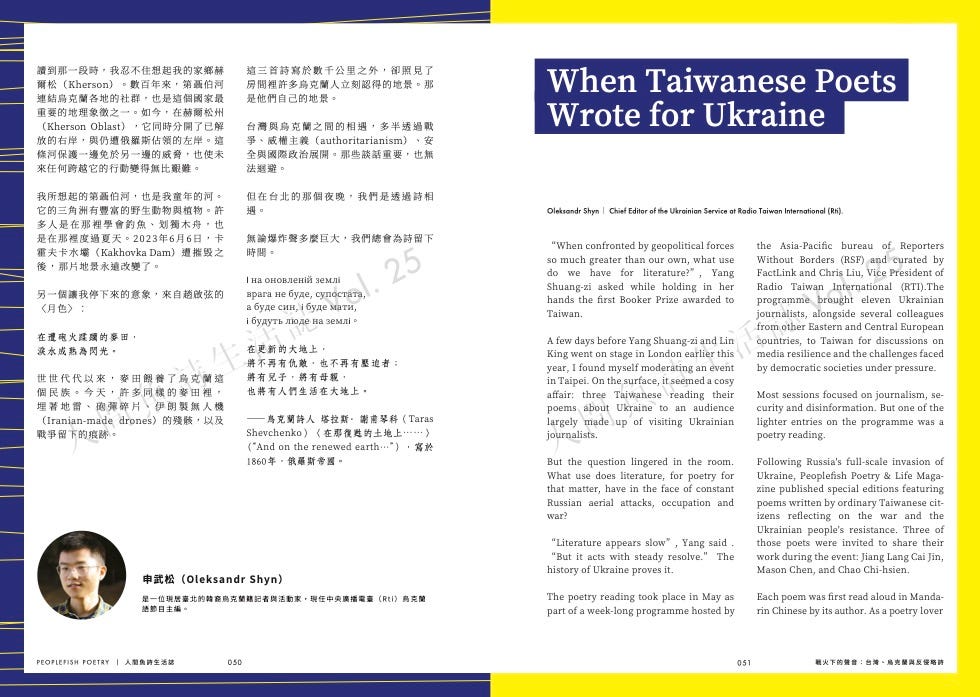
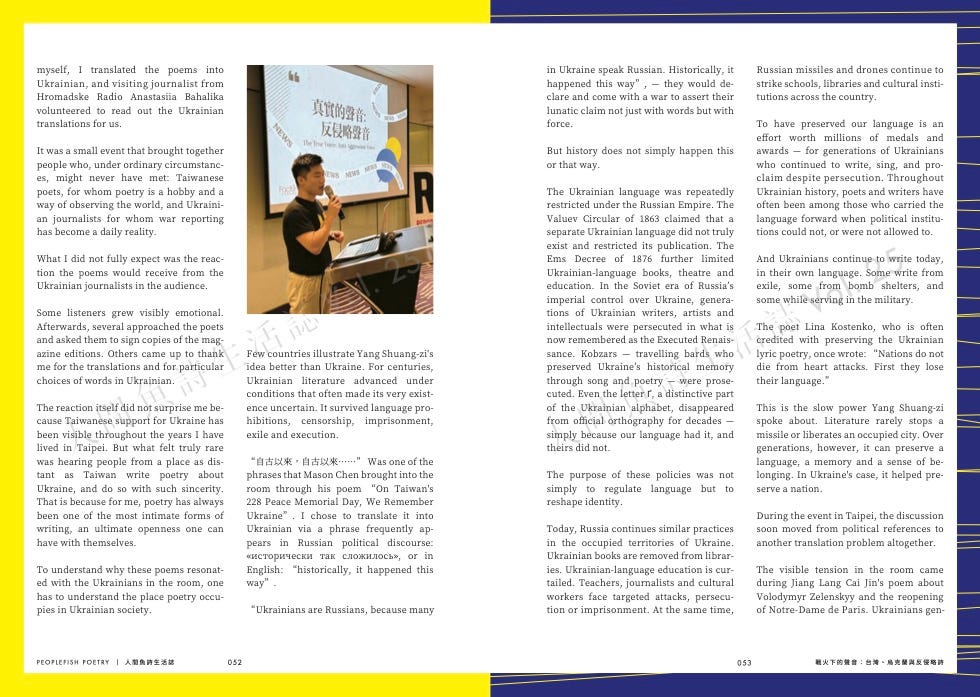
This article is republished with permission from Peoplefish Poetry & Life: “When Taiwanese Poets Wrote for Ukraine.”
Special thanks to Huang Guan(黃觀), Editor-in-Chief of Peoplefish Poetry & Life.