
Through a Taiwanese Fact-Checking Lens: Deconstructing China’s Disinformation Playbook Against Japan

Feb 22, 2026
Authors: Summer Chen, Mary Ma, Wei-Ping Li
Data support: FIMI Intelligence Dashboard by Doublethink Lab
After Japanese Prime Minister Sanae Takaichi raised the issue of “a Chinese attack on Taiwan could constitute an existential crisis for Japan” (the statement will be referred to as the “Taiwan contingency statement” hereafter), the CCP not only launched diplomatic protests but also activated a range of countermeasures, rapidly escalating Sino-Japanese tensions. From Taiwan’s perspective, this bears a striking resemblance to the diplomatic protests, economic sanctions, and information warfare the CCP launched against Taiwan during former U.S House Speaker Nancy Pelosi’s visit to the island in 2022.
Initially, the CCP’s targets in these two incidents seem different. However, veteran journalist Lee Chih-te, a former director of the Asia Fact Check Lab with experience in cross-strait and defense reporting, pointed out: “Both incidents shared a common context as diplomatic breakthroughs for Taiwan, and the CCP’s reactions were retaliatory, prompted by the crossing of its perceived diplomatic red lines.”
Takaichi’s “Taiwan contingency statement” didn’t come from nowhere — they were a response to the CCP’s increasing threats across the Taiwan Strait. In August 2022, the CCP conducted its largest military exercises around Taiwan since 1996 in protest of Pelosi’s visit, with five missiles landing in Japan’s exclusive economic zone near Okinawa. This situation meant that cross-strait tensions were no longer just a matter between Taiwan and the CCP. Furthermore, they directly affected Japan’s national security and pushed Japan’s political discussion on the strategic implications of a “Taiwan contingency.”
Based on extensive experience in fact-checking disinformation in Taiwan and the Chinese-language information sphere, the FactLink team examined the similarities and differences in the CCP’s information and propaganda strategies against Taiwan and Japan during “diplomatic red line” incidents from a Taiwanese perspective. It also offers insights from Taiwan’s frontline experience to our allies in Asia, including Japan, in developing information defense strategies.
Finding One: Although the CCP's propaganda infrastructure varies for Taiwan and Japan, its responses during "Red Line" incidents are remarkably similar.
The CCP’s propaganda agencies targeting Japan and Taiwan are separate entities. However, when the CCP reacted to Takaichi’s comments on the “Taiwan contingency” in parliament, its response closely resembled the tactics used after Pelosi’s 2022 visit to Taiwan. In both instances, the CCP launched diplomatic protests, imposed economic sanctions, engaged in information and public opinion campaigns, and issued military threats.
The CCP agency responsible for Taiwan affairs includes the United Front Work Department and the Taiwan Affairs Office. Since 2024, military propaganda has been coordinated by the Eastern Theater Command Integrated Media Center, which acts as a “central kitchen” producing promotional content. This material is shared concurrently by Chinese state media, online forums, and social media platforms, often spreading rumors that align with official messages.
In response to Takaichi’s comments, the CCP’s Ministry of Foreign Affairs, the Chinese Embassy in Japan, and Ambassador Wu Jianghao issued condemnations. Notably, Consul General Xue Jian of the Chinese Consulate in Osaka posted a “beheading” message on X on November 8, 2025. Although it was quickly deleted, this incident triggered a diplomatic exchange between China and Japan. Chinese diplomats in Japan also launched attacks on social media in both Chinese and Japanese. Additionally, the Chinese official foreign propaganda outlet, China News Service [中國新聞網], actively posted news reports and AI-generated editorial cartoons on X. Chinese political-oriented online Weibo influencers (”大V”) with close ties to China also echoed the official narrative.
What is particularly noteworthy is that the dissemination of disinformation across social platforms, in terms of its circulation paths and methods, was remarkably similar in both the Taiwan-focused and Japan-focused cases.
For example, following Takaichi’s comment about a “Taiwan contingency,” a piece of disinformation aimed at sowing discord between Taiwan and Japan falsely claimed that Hsieh Chang-ting, a former Taiwanese representative to Japan, had exchanged jewelry with Takaichi for political favors for Taiwan. The disinformation even included a fake document as supposed evidence, tarnishing the Taiwan-Japan relationship by depicting it as “bribery diplomacy.”
The actors behind this disinformation campaign used a fabricated “hack-and-leak” method designed to weaken Taiwan-Japan diplomatic relations and discredit Takaichi’s “Taiwan contingency” strategy. This approach combined a fake “dark-web leak” incident with forged documents, mirroring information attacks Taiwan had faced at key diplomatic moments, such as Pelosi’s 2022 visit, President Tsai Ing-wen’s 2023 US transit, and Vice President Lai Ching-te’s 2023 visit to Paraguay. All these events followed the same pattern: a fake “dark-web leak” paired with forged documents.
The FactLink research team has published a separate analysis focusing on the "fake dark-web leak + forged document" attack method.

Finding Two: X (Twitter) and Weibo Are China's Primary Battlegrounds for External and Internal Propaganda
Weibo and X (Twitter) are the primary platforms to monitor closely during heightened cross-strait tensions or when diplomatic incidents between China and Japan arise. For example, during Pelosi’s visit to Taiwan, both Russian state media RT and the Chinese media Global Times closely tracked and commented on Pelosi’s movements in real time on X. Meanwhile, X was also a hotbed for disinformation, with true and false information competing for attention and attempting to shape international opinion.
Regarding Chinese platforms aimed at Chinese audiences, such as WeChat, Weibo, and various forums, these serve as channels for disseminating official Chinese narratives and propaganda. Chinese state media utilize Weibo to pressure Taiwanese entertainers into issuing loyalty statements and to amplify the activities of pro-China groups protesting in Taiwan by manipulating Weibo’s “trending topics” list, thereby increasing the visibility of topics endorsed by the CCP. Additionally, it is customary for Chinese state media to leverage Weibo in mobilizing patriotic sentiments among Chinese citizens, as Chinese actors have constantly used Weibo to fuel anti-Japanese sentiment among Chinese internet users. Numerous incidents have demonstrated that such heightened nationalist feelings can impact Japanese companies operating in China and compromise the safety of Japanese travelers.
Finding Three: Similarities and Differences in Information Warfare Narratives Targeting Taiwan vs. Japan
The FactLink research team tracked X posted from November 1 to December 6, 2025, gathering rumors about Takaichi’s comments on the “Taiwan contingency.” These rumors can be grouped into seven categories:
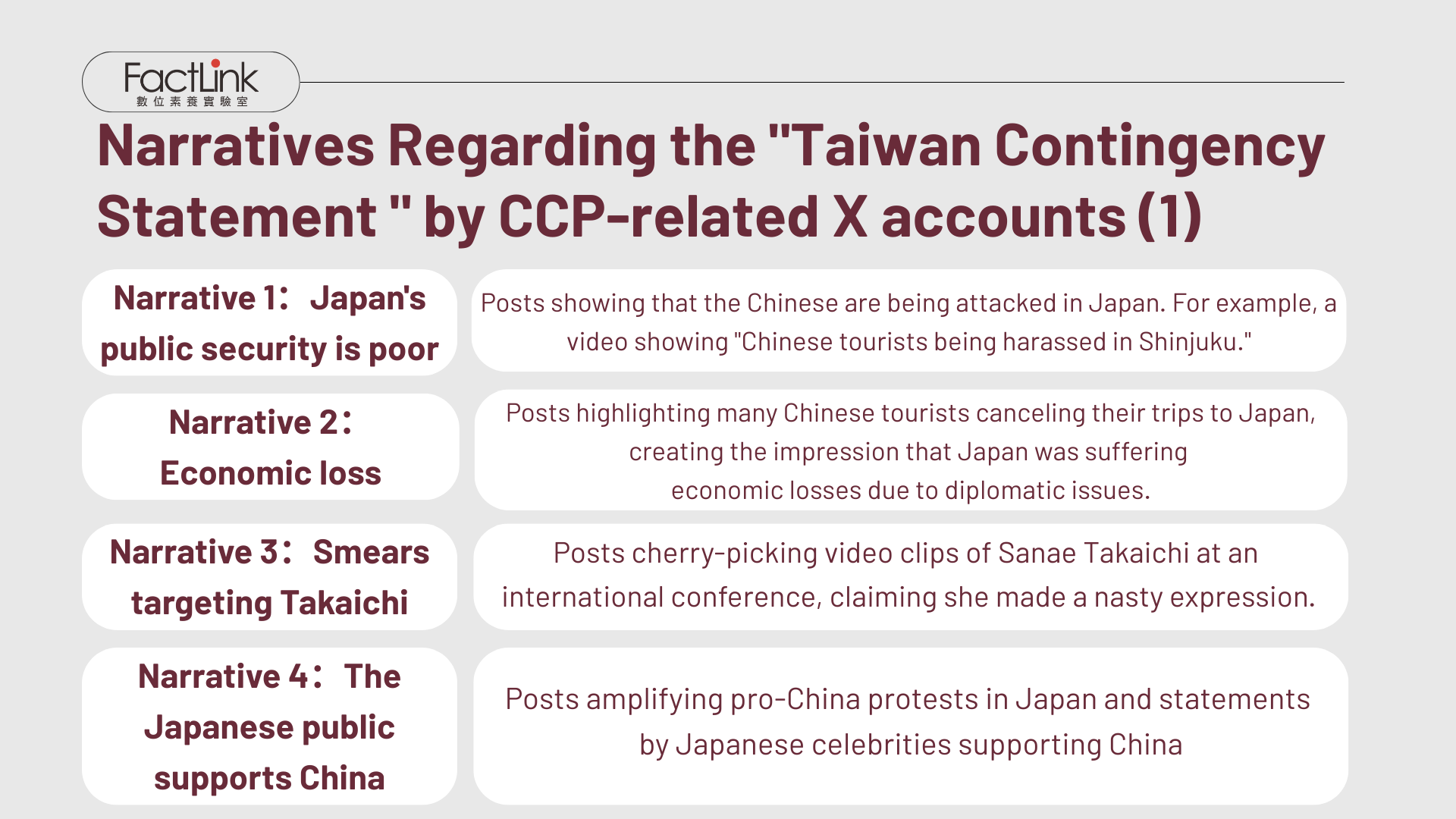
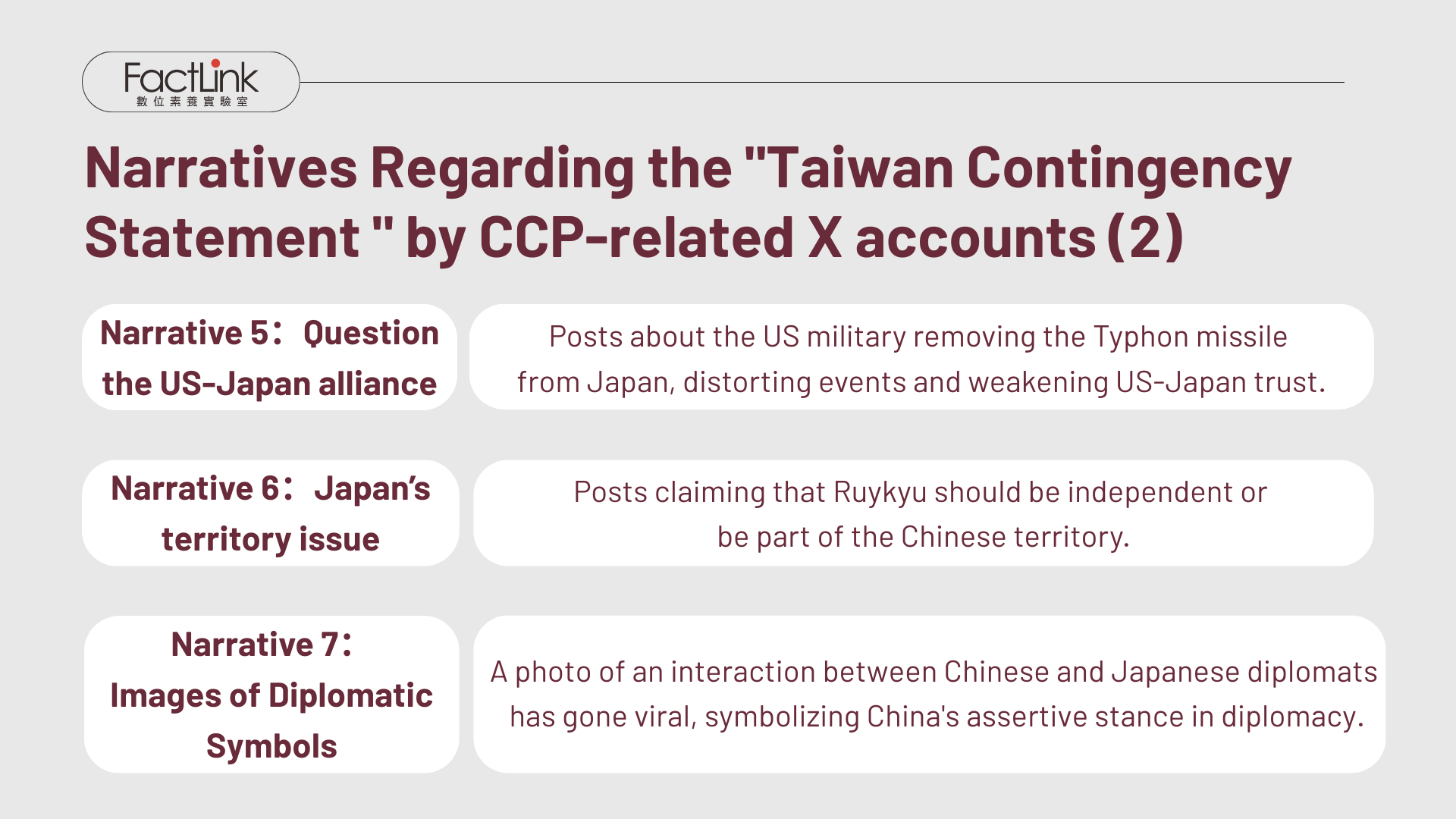
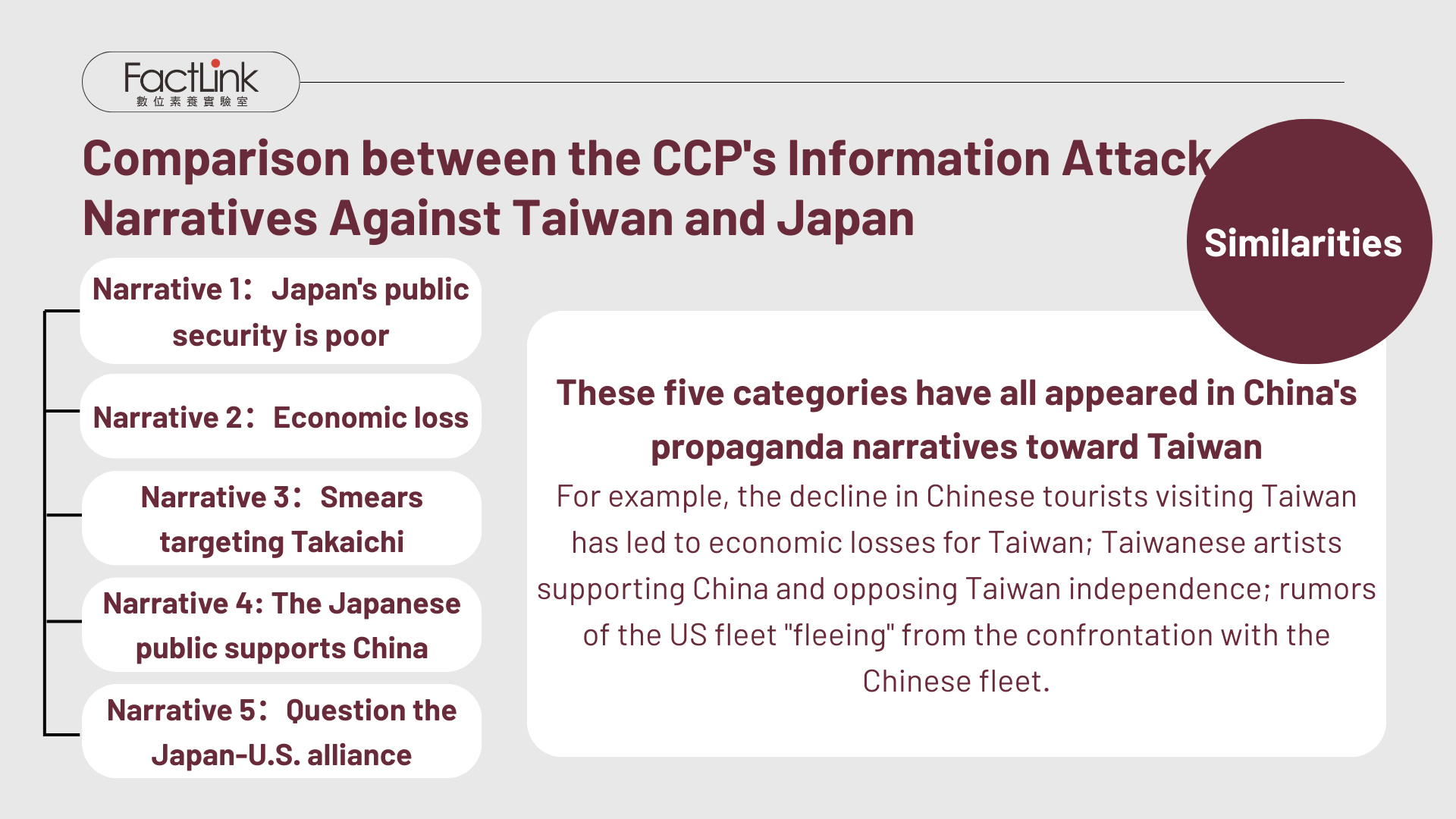
Among the seven narrative categories, the first five — Japan's deteriorating public safety, economic losses, smearing Takaichi, pro-China public opinion in Japan, and questioning the US-Japan alliance — have also appeared in the CCP's propaganda targeting Taiwan.
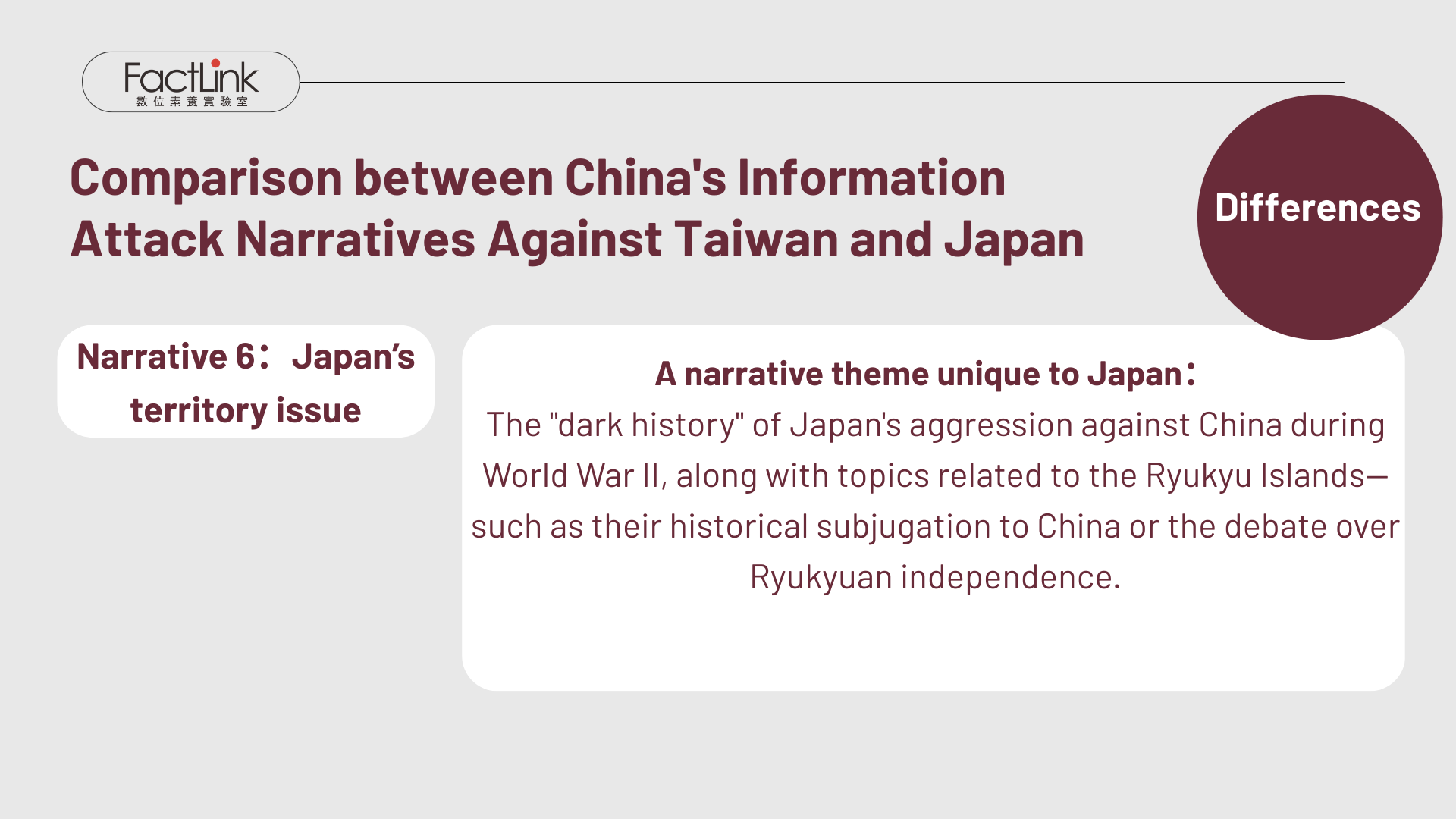
The sixth category, Japan’s historical territorial dispute, is a narrative unique to Japan. The FactLink team noted two surges in Japan-related posts on Chinese social platforms in 2025: the first in June–July during the promotion of the Chinese anti-Japanese war film Nanjing Photo Studio, and the second in September during China’s military parade commemorating the 80th anniversary of Japan’s defeat in World War II.
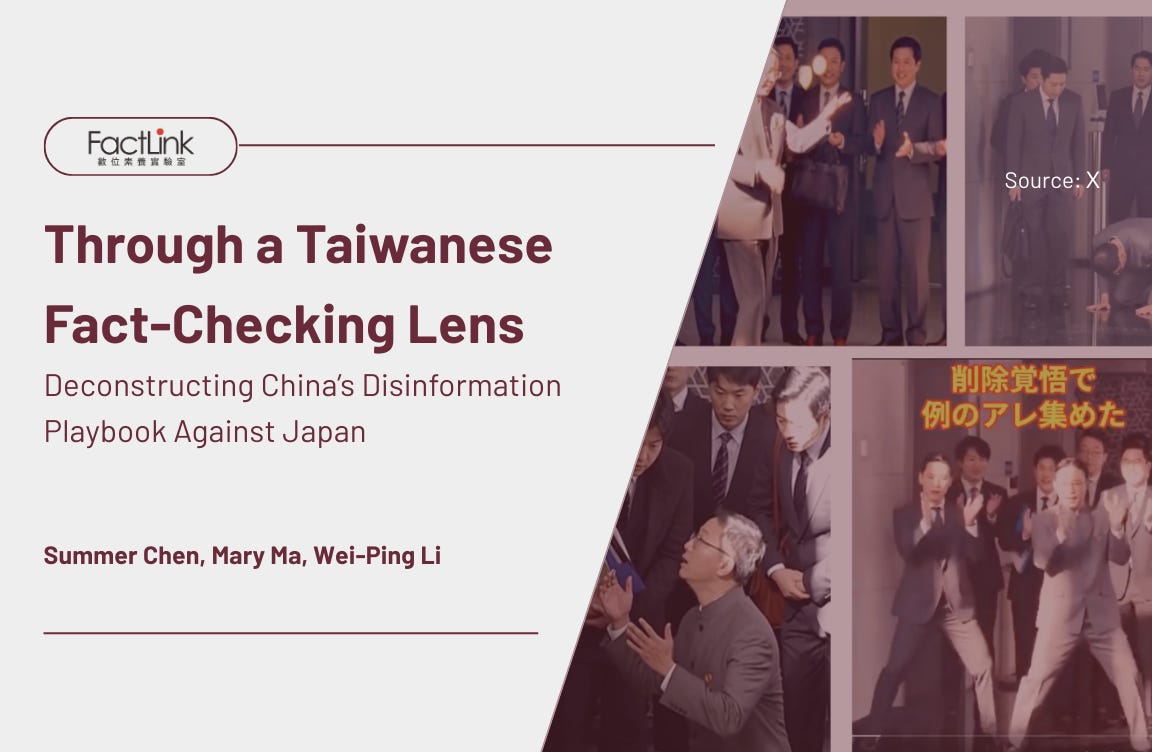
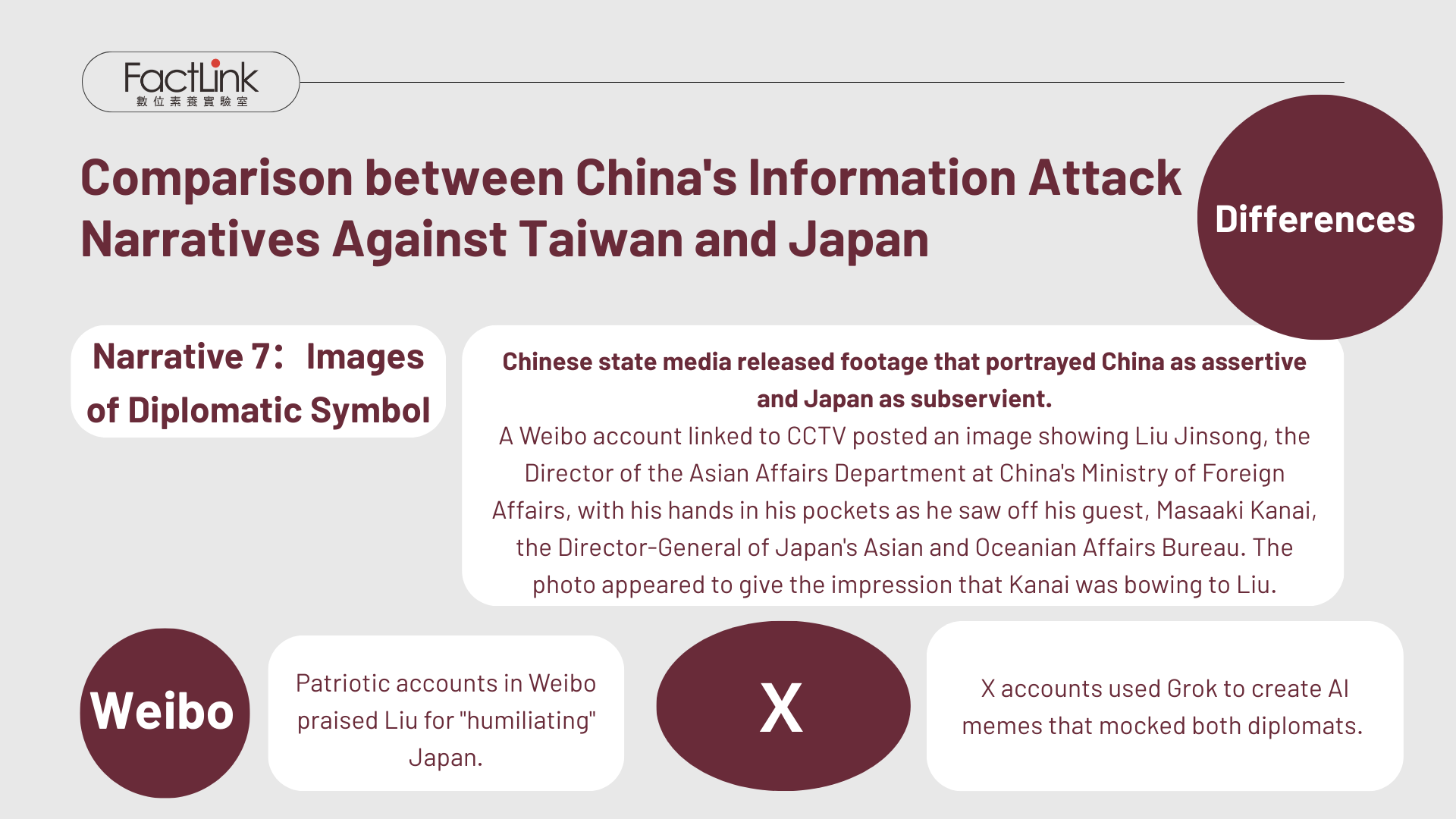
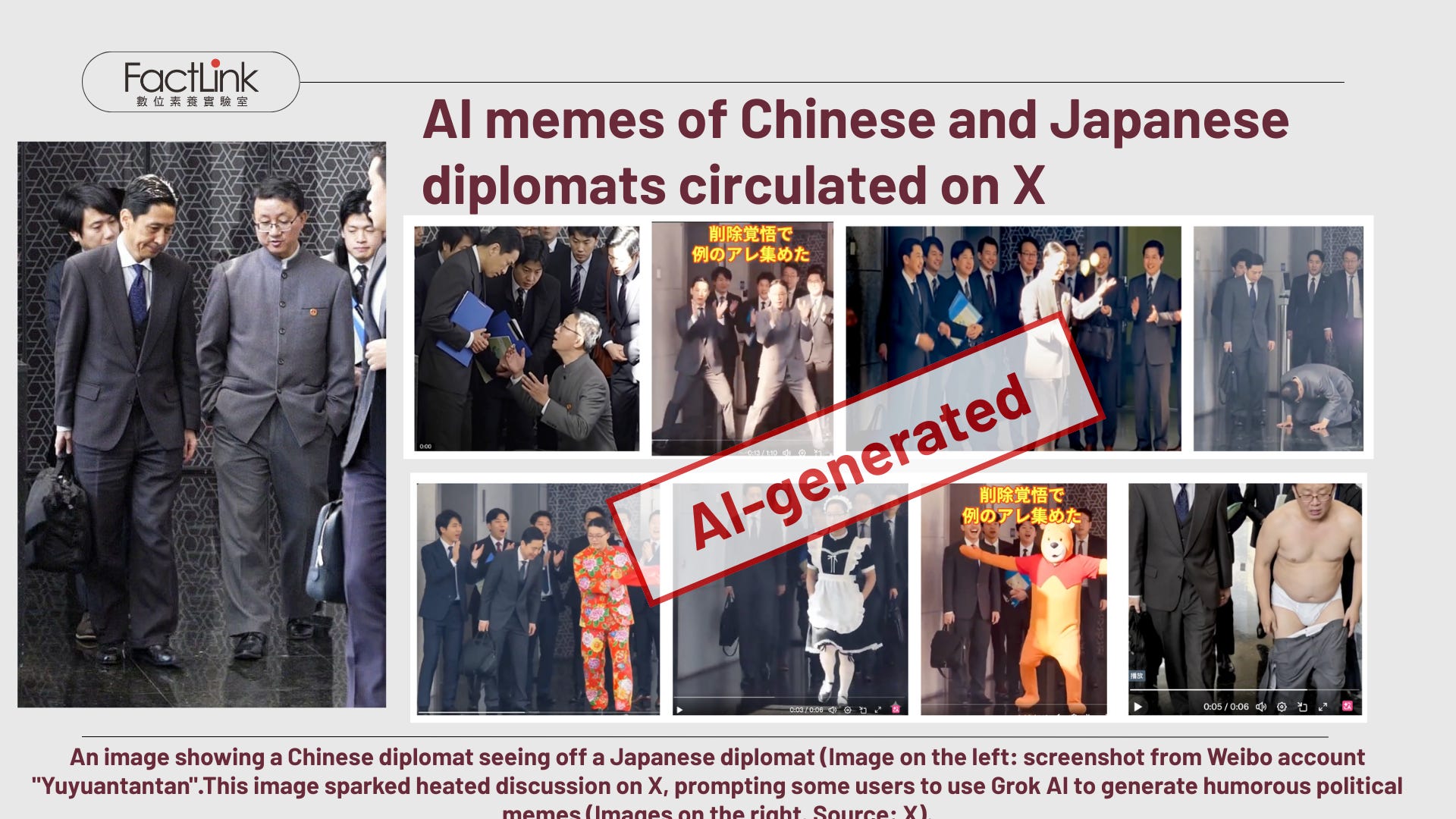
The seventh category features messaging from the CCTV-affiliated account “Yuyuan Tantian,” which posted an image of China’s Director General for Asian Affairs, Liu Jinsong, in uniform, hands in pockets, while Japan’s Director General for Asian and Oceanian Affairs, Kanai Masaaki, was shown bowing respectfully as the two bid goodbye. The imagery symbolized China as dominant and Japan as submissive. Subsequently, a large number of political memes mocking Japanese diplomats were shared on X.
Finding Four: From Diplomatic Protests to Legal Warfare at the United Nations — The CCP Escalated Hybrid Threats Against Japan
The CCP effectively used a mix of propaganda, economic sanctions, and diplomatic warnings to respond to Takaichi’s “Taiwan contingency statement.” Between late November 2025 and January 2026, Chinese officials repeatedly accused Japan at the United Nations of breaching the international norms established after WWII and the UN Charter.
Following Takaichi’s “Taiwan contingency statement,” U.N. Permanent Representative of China, Fu Cong, and Deputy Sun Lei addressed the U.N. Security Council and other venues multiple times. They accused Japan of openly declaring nuclear ambitions, amending three security laws, and celebrating its history of aggression with right-wing support. They argued that these actions suggested a revival of militarism that disregarded the post-WWII international framework and endangered regional stability. Fu Cong and Sun Lei also questioned Japan’s eligibility for a permanent Security Council seat in the U.N. and criticized Takaichi for linking Taiwan’s situation to Japan’s “survival crisis,” calling it an inappropriate intrusion into China’s sovereign affairs and a breach of the post-WWII international legal order and the U.N. Charter.
In late November to December 2025, Chinese state media amplified Sun Lei’s statements from October 9, 2025, in which he discussed the “undetermined status of the Ryukyu Islands” at the U.N. He argued that neither the Cairo Declaration nor the Potsdam Proclamation, which established the post-WWII order, mentioned the Ryukyus. Additionally, the 1951 San Francisco Peace Treaty, which governed the postwar settlement, did not specify their return to Japan, leaving the sovereignty of the Ryukyus unresolved. Sun Lei also asserted that the U.N. has never recognized Japan’s sovereignty over the islands.
In this incident, the CCP leveraged the U.N. as a platform to influence international dialogue and shift global public opinion. This strategy extends beyond traditional “information warfare” to include legal warfare as part of hybrid threats.
Moreover, it aligns with what Pulitzer Prize-winning journalist Anne Applebaum wrote in her book, Autocracy, Inc., that authoritarian regimes like Russia and the CCP deliberately intervene in international organizations such as the U.N. to influence global debate and reshape the international information landscape.
Recommendations for Enhancing Building Information Security
While the CCP uses different actors for information and propaganda efforts targeting Japan and Taiwan, it follows consistent patterns and “scripts” in its disinformation and propaganda campaigns whenever it considers a diplomatic red line has been crossed. The “dark-web leak + forged document” tactic has been used in both the CCP’s information attacks on Taiwan and Japan during such “red line” incidents. These cases, covering different events and regions, show remarkably similar attack methods — a pattern that calls for closer examination.
That said, this technique functions somewhat differently in the contexts of Taiwan and Japan. When targeting Taiwan, Chinese state media and political opinion accounts typically pick up and amplify Taiwanese media reports or online rumors only at the very end of the information chain, inflating online engagement. In contrast, in the Takaichi “Taiwan contingency” incident, Chinese political opinion accounts, closely affiliated Facebook pages, and Hong Kong media were clearly involved in the propaganda campaign. One possible reason is that Taiwanese citizens, after years of experience fighting the CCP’s propaganda, are highly cautious of information from Chinese sources. As a result, information manipulators have increasingly shifted to a more “invisible” distribution model when targeting Taiwan.
Additionally, Weibo and X are the CCP’s main platforms for diplomatic countermeasures to manipulate both “international public opinion” and “domestic public sentiment.” Therefore, it is essential to monitor and track these two social platforms when analyzing information warfare.
Furthermore, advances in AI technology have enabled malicious actors to quickly create content in multiple languages and various contexts, even producing short AI videos rapidly in response to breaking news. Researchers need to broaden their focus to include platforms such as Instagram Reels, YouTube Shorts, and TikTok.
Over the past few years, Taiwan and Japan have adopted different strategies for their information defenses. This article suggests that “information defense” should go beyond government-issued press releases to clarify information. Instead, civil society, media, and citizens should work together to create an information defense frontline. In particular, Taiwanese and Japanese media, fact-checking organizations, research institutions, and civil society groups should exchange knowledge, learn from each other, share insights, collaborate on developing response mechanisms, and improve technical capacity and skills for more effective responses in the future.