
The Messaging Machine in Motion: Unpacking China’s Propaganda Drive Against Japanese Prime Minister Sanae Takaichi’s Taiwan Remark

Wei-Ping Li, Summer Chen, Mary Ma, Athena Tong
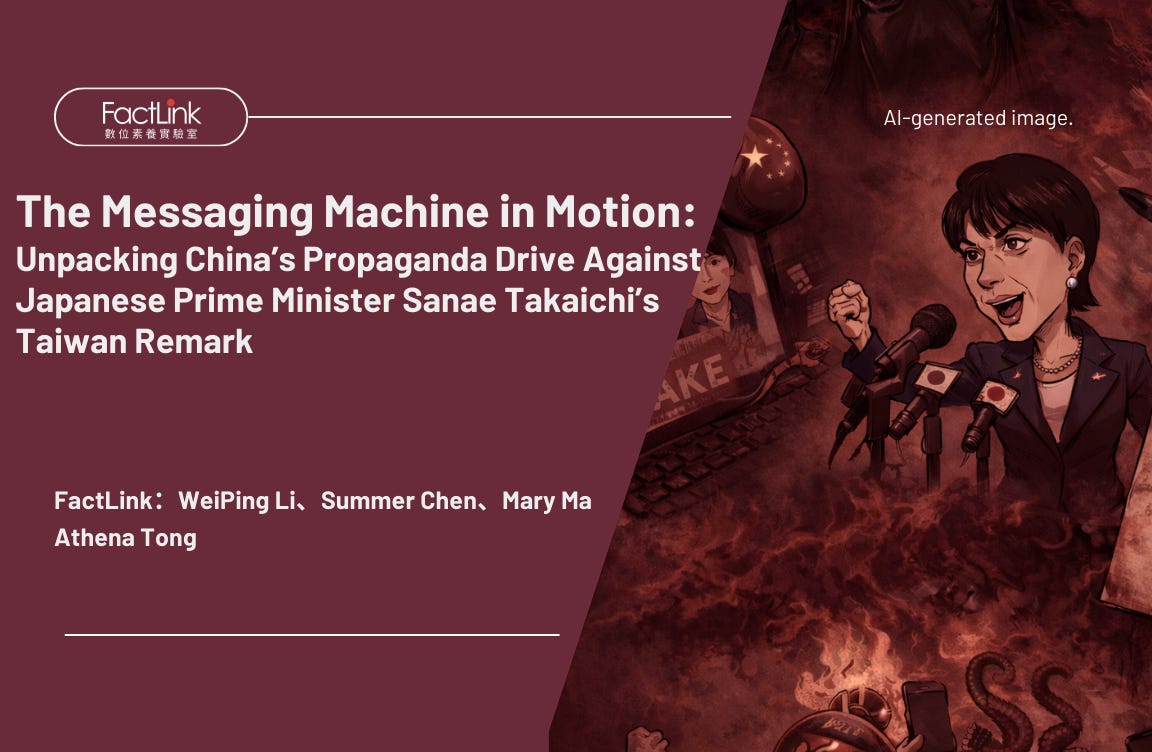
Relations among Japan, China, and Taiwan have entered a new phase since Sanae Takaichi became Japan’s Prime Minister in October 2025. On November 7, 2025, while responding to a legislator’s questions in parliament, she invoked the phrase “Taiwan contingency,” triggering diplomatic tensions between China and Japan. Backed by the strong support among the Japanese public, Takaichi then dissolved the Lower House and called an early election on February 8. Under her leadership, the Liberal Democratic Party (LDP) secured a landslide victory. These election outcomes are poised to influence the broader relationships among Japan, China, and Taiwan.
Since Takaichi took office, China’s state propaganda apparatus has actively conducted online information campaigns targeting both Chinese citizens and international audiences. These efforts aim to intensify existing anti-Japanese sentiment within Chinese society and realign historical narratives about Taiwan and the Ryukyu Islands’ sovereignty, in line with the Chinese Communist Party (CCP)’s preferred narratives and geopolitical objectives on the global stage. Building on FactLink’s expertise in countering Chinese-language disinformation and information operations, the FactLink team collaborated with Athena Tong, Visiting Researcher at the University of Tokyo and Program Lead at the China Strategic Risks Institute (CSRI), to jointly publish five research reports.
These reports analyze the “playbook” of CCP’s propaganda, beginning with CCP’ s attacks against Prime Minister Takaichi’s “Taiwan contingency” statement, through the dissolution of parliament and the call for a snap election, culminating on election day. The reports examine the content of messages and actors in CCP’s information campaigns and disinformation activities, as well as the responses of Japanese society. The findings aim to support Taiwan–Japan collaboration in information security research, fact-checking, and enhancing information resilience.
CCP’s Propaganda Playbook on the “Taiwan Contingency”
Among the three reports by the FactLink team, the first, “From Misogyny and Historical Enmity to Geopolitical Rivalry: Deconstructing CCP’s Playbook of Narrative Attacks Against Japan,” reveals that CCP’s official stance on Japan’s “Taiwan contingency” was first articulated in aggressive terms by Chinese diplomats in Japan, with further amplification by state media and influential social media commentators. In this playbook, each Chinese actor played a specific role in creating or spreading aligned messages. The primary themes used against Japan included historical grievances from World War II, geopolitical rivalry, and misogynistic attacks. Recognizing the actors and themes within the CCP’s official messaging is essential for developing effective information resilience and defence strategies.

CCP’s Disinformation Playbook Following the Crossing of Diplomatic Red Lines
The second report, “Viewing the ‘Taiwan Contingency’-related Disinformation Through a Taiwanese Fact-Checking Lens: Deconstructing CCP’s Disinformation Playbook Against Japan,” draws on the experience of FactLink team members as Taiwanese fact-checkers. It finds that when the CCP perceives its diplomatic “red lines” as being crossed, social media disinformation tends to follow standardized playbooks. According to FactLink’s observations, CCP’s countermeasures against Takaichi over her “Taiwan contingency” statement included diplomatic pressure, economic signaling, and information warfare, which closely resembled the hybrid coercive measures that CCP deployed after then–U.S. House Speaker Nancy Pelosi’s visit to Taiwan in 2022. In both cases, the CCP perceived the events as diplomatic advantages for Taiwan and responded with hybrid threats.

Dark Web “Leaks” and Fabricated Documents as a Diplomatic Sabotage Tactic
The third report, “A Classic Information Manipulation Tactic in Diplomatic Sabotage: Dark Web ‘Leaks’ and Fabricated Documents,” offers a detailed look at the method used to spread false claims that Takaichi, during her time as a legislator, received jewelry from Taiwanese diplomat Frank Hsieh. The disinformation technique, including alleged “dark web leaks” and counterfeit documents, mirrored patterns seen in attacks targeting Taiwan, especially during every diplomatic breakthrough by Taiwan with other countries. The report examines this diplomatic smear strategy, comparing how it was employed similarly and differently in the contexts of Taiwan and Japan.
While FactLink’s reports analyze narrative and disinformation attacks against Japan from Taiwan’s perspective, Athena Tong’s analyses focus on the CCP’s information attacks from the viewpoint of Japanese society.

Japan’s Responses to the CCP’s “Taiwan Contingency” Narratives
In her two analyses, “Examining the Influence of the CCP’s ‘Taiwan Contingency’ Propaganda from the Perspective of Japanese Society: How Japanese Media and Society Reacted” and “Deconstructing the CCP’s Narratives on Japan’s House of Representatives Election,“ Tong explained how Japanese media, government institutions, and civil society responded to the series of threats imposed by the CCP.
Tong noted that from the eve of Japan’s House of Representatives election through voting day, the CCP adopted a dual-track strategy. While the CCP’s Foreign Ministry publicly claimed it would not interfere in Japan’s internal affairs, Chinese state media and social platforms simultaneously framed the election as a “revival of right-wing militarism,” “binding Japan’s fate to the war machine of aggression against China,” and “support for Taiwanese independence.”
Chinese state media also distorted and sensationalized an incident in which Takaichi injured her hands during the campaign, recasting it through conspiracy-laden narratives that portrayed her as “mentally and physically unstable,” “emotionally collapsing,” or “unwilling to share the stage with the opposition.” Nevertheless, these information-manipulation techniques ultimately did not influence Japanese voters’ intentions. In addition, the CCP’s economic pressure campaign failed to sway the election, as Japan has long pursued an “economic security” policy that limited its impact on public opinion.
Based on our research and analysis, we proposed the following recommendations for civil society in Taiwan and Japan, journalists, fact-checkers, policymakers, and other stakeholders interested in combating transnational information warfare.
1.The CCP’s Employment of Hybrid Coercion Has Developed into a Consistent Framework.
When the CCP determines that its “diplomatic red lines” have been crossed, it frequently enacts multiple measures concurrently, including diplomatic protests, economic sanctions, military drills, and information or cognitive warfare. These actions have developed into a relatively established framework of hybrid coercion. Within this framework, the CCP’s information campaigns and disinformation operations follow a playbook of recurring propaganda themes and disinformation scripts. Therefore, systematically identifying the CCP’s narrative themes and disinformation tactics aimed at Japan and Taiwan is a crucial step in developing strategies to enhance information resilience.
2.Developing countermeasures against disinformation playbooks during diplomatic crises is essential.
When the CCP perceives that its diplomatic red lines are breached, certain types of disinformation tend to spread on social platforms. This disinformation often follows familiar scripts and operational patterns carried out by specific actors. For instance, a typical technique of disseminating ‘fabricated dark-web leaks’ using forged documents has been identified in disinformation campaigns targeting Taiwan and Japan. Countries facing similar threats could improve cooperation in fact-checking, research, and information sharing to recognize recurring disinformation, anticipate future trends, and leverage these insights to create training programs for cybersecurity specialists, journalists, and media literacy educators.
3.Greater emphasis should be directed towards legal warfare and contestation within international institutions.
The CCP’s hybrid tactics against Japan extend beyond information warfare; they also involve legal and diplomatic contestation within established international institutions such as the United Nations, particularly regarding the postwar international order and matters of sovereignty. These forms of legal confrontation are relatively unfamiliar to Taiwanese information researchers, highlighting the need to strengthen research capabilities in this area.
4.Focus on Weibo and X when monitoring Chinese information campaigns.
Weibo and X are important platforms for the CCP actors to promote messages and influence public opinions during pivotal moments, such as Sino-Japanese diplomatic tensions or crises in the Taiwan Strait. Researchers should stay alert and closely observe content on both platforms.
5. Deepening Taiwan–Japan Cooperation in Fact-Checking and Cybersecurity
Taiwanese fact-checkers and cybersecurity researchers have gained substantial experience in Chinese information interference operations. As cooperation and exchanges among Taiwanese and Japanese media, fact-checking groups, and think tanks grow deeper, both sides can work together to strengthen their ability to combat information manipulation.
* We sincerely thank Doublethink Lab for supplying data support via its FIMI Intelligence Dashboard.
**FactLink will soon release a “practitioner’s version” based on the five reports. If you are a fact-checker, cybersecurity analyst, think tank member, or government employee and wish to access the “Practitioner’s version,” please complete this form. We will send you a copy once it is published.