
From Misogyny and Historical Enmity to Geopolitical Rivalry: Deconstructing China’s Playbook of Narrative Attacks Against Japan

Wei-Ping Li, Summer Chen, Mary Ma
Data support: FIMI Intelligence Dashboard by Doublethink Lab
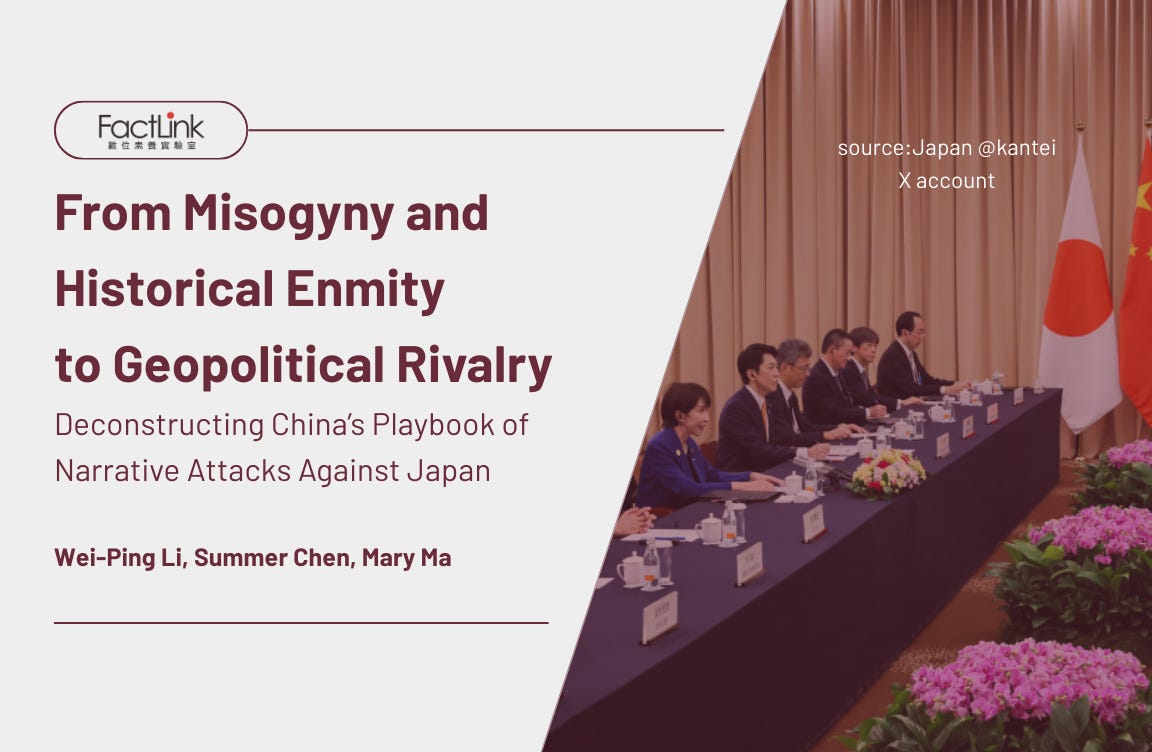
In October 2025, Sanae Takaichi became Japan’s first female Prime Minister, marking a new chapter in the triangular relationship between Japan, Taiwan, and China. However, her political stance and the remark that “a Chinese attack on Taiwan could constitute an existential crisis for Japan” (hereafter referred to as the “Taiwan contingency statement”) sparked widespread anti-Japanese sentiment online in China. Chinese officials, state media, and Weibo influencers focusing on political commentary (known as “Political Big Vs”)1 also launched a campaign that not only targeted Takaichi’s gender but framed their narratives around the World War II historical grievances and geopolitical issues. The information campaign projected China’s hardline policies and engaged in debates over Ryukyu sovereignty, history, and international law, exemplifying how the Chinese Communist Party (CCP) uses domestic and international propaganda to reinforce its narratives and influence public opinion within China and globally.
This report analyzes the actors and themes behind the CCP’s online influence campaign from November through early December 2025, following Takaichi’s assumption of the premiership, to identify the Chinese propaganda playbook, including the roles and scripts of the various actors involved—from official government and state media online accounts to Big V influencers.
The key findings of this report are:
Following Takaichi’s “Taiwan contingency statement” on November 7 that a Chinese military attack on Taiwan “could pose an existential crisis for Japan,” Chinese diplomatic officials in Japan were among the first to respond on X. However, the CCP’s propaganda campaign, amplified by Big V influencers targeting Chinese audiences, only gained momentum after state media announced the official position on November 10.
Since Takaichi assumed office, the CCP’s information campaigns aimed at her have centered around three main themes:
The CCP’s long-standing narrative about China-Japan-Taiwan relations, including Japan’s colonial rule over Taiwan and its wartime atrocities against China. The CCP also characterized Takaichi’s statements and actions as promoting Taiwanese independence, while also reviving Japan’s militarism and expansionist ambitions, which could threaten regional stability.
A geopolitical sovereignty and conflict narrative: In addition to reiterating that Taiwan is part of China, the CCP revived the “undetermined sovereignty of Ryukyu” debate, emphasizing China’s historical ties to the Ryukyu Kingdom and asserting that Ryukyu’s sovereignty has been disputed since World War II. Additionally, seizing on Japan’s consideration of missile sales to the Philippines, a country that has repeatedly clashed with China in the South China Sea, the CCP framed this as “collusion between Japan and the Philippines” and attacked the Japan-Philippines-U.S. alliance while stoking nationalist outrage across Chinese social media.
A notable aspect of this wave of propaganda was how it focused on Takaichi’s identity as a woman. Chinese political “Big V” accounts, which frequently comment on politics to align with the government’s views, used discriminatory language to portray Takaichi’s interactions with Taiwanese and other international leaders. They even employed metaphors related to extramarital affairs or used derogatory language about women to describe Japan’s relationships with Taiwan and the United States.
An Escalating Information War: A Chronicle of China-Japan Diplomatic Incidents Since Takaichi Took Office
Before Takaichi took office in October 2025, the CCP had already ramped up its anti-Japanese propaganda efforts. Two critical films about Japan’s wartime aggression, “The Nanjing Photography Studio” and “Unit 731,” were released in theaters.2On September 3, 2025, the 80th anniversary of Japan signing the surrender documents in 1945, the CCP held a large military parade to celebrate “Victory over Japan Day.” On October 24, the Standing Committee of the National People’s Congress declared the creation of a “Taiwan Retrocession Commemoration Day,” emphasizing its role as “a firm commitment of all ethnic groups to uphold the One China principle and protect national sovereignty and territorial integrity.”3Alongside these official events, a widespread online propaganda campaign unfolded, including a large number of videos on platforms like Douyin showing viewers shedding tears for national grievance after watching the films, or foreigners praising China’s military after the parade.
Takaichi’s comments about Taiwan after her election further intensified Chinese nationalist reactions. On November 1, she met Taiwan’s representative, Lin Hsin-yi, during the APEC summit,4referring to him as “Presidential Policy Advisor of Taiwan”—a title that immediately prompted Chinese protests for suggesting Lin was representing “Taiwan’s president.”5Before long, on November 7, in response to a legislator’s question in parliament, Takaichi mentioned that a Chinese attack on Taiwan “could pose an existential threat to Japan,” seemingly to hint at the circumstances under which Japan might justify using force in self-defense.6
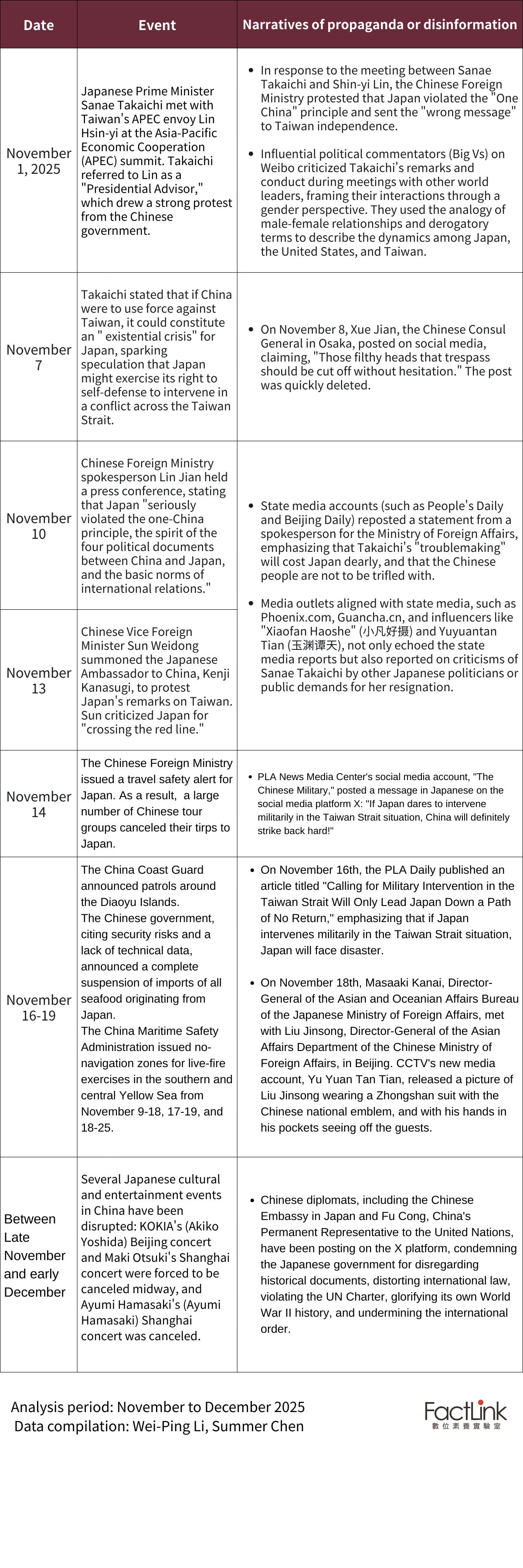
The very next day, China’s Consul General in Osaka, Xue Jian, posted on X: “Those filthy heads that barge in uninvited should be severed without hesitation. Are you prepared for the consequences?”7 Although Xue quickly deleted the post, Takaichi’s statement further sparked intense backlash from the Chinese government. China’s Ministry of Foreign Affairs responded with protests and measures such as summoning the Japanese ambassador, issuing travel advisories for Japan, and suspending Japanese aquatic imports. In mid-to-late November, China’s Maritime Safety Administration announced live-fire exercise exclusion zones in the southern and central Yellow Sea on three occasions, leading to international and Taiwanese media speculation that China was signaling a military warning to Japan.8 Starting mid-November, performances by Japanese singers in China were also impacted:9Yoshida Akiko’s Beijing concert was suddenly canceled before opening night; Otsuki Maki was escorted offstage during her Shanghai performance; and Hamasaki Ayumi’s fully sold-out Shanghai concert was canceled at the last minute. After this incident, Hamasaki posted footage of her performing to 14,000 empty seats, causing shock among the public.
Table: A Comparison Table of Sino-Japanese Diplomatic Incidents and Narratives of Propaganda and Rumors
From Weibo to X: China’s Dual-Front Information War, Domestic and International
Social media platforms are crucial tools for both external and internal propaganda in the CCP’s information warfare: while Weibo serves as a key platform through which the CCP shapes domestic public opinion,10 X.com, formerly Twitter, functions as an online arena for Chinese diplomats to advance international narratives.11At the same time, X is a major social platform in Japanese society,12 serving as a stage for Chinese diplomats stationed in Japan to express Beijing’s positions. To understand the propaganda campaign the CCP launched following Sanae Takaichi’s assumption of office, Weibo and X are essential observation fields.
To investigate the propaganda campaign the CCP mounted after Takaichi took power, the FactLink team applied content analysis methods to analyze Weibo posts and monitored the posts of Chinese diplomatic officials on X. Using the FIMI Intelligence Dashboard provided by Doublethink Lab, FactLink collected 15,241 Weibo posts containing the keyword “Takaichi Sanae” from November 1 to December 6—one month after Takaichi’s “Taiwan contingency” statement on November 7. Analysis of X posts focused on the dates and content of posts by Chinese diplomatic missions and officials, compared against the timeline of Weibo activity, to identify the key actors and narrative themes in the influence operation.
Trends in Weibo Post Volume and Account Analysis
The Weibo post timeline indicates that Takaichi’s November 1 reference to Lin Hsin-yi as “Presidential Advisor of Taiwan” sparked a brief discussion lasting just two days. After Takaichi’s “Taiwan contingency statement” in the Japanese parliament on November 7, a large online debate was not immediately seen on Weibo, either. It was only when China’s Ministry of Foreign Affairs commented on Takaichi’s statement during its November 10 press conference that state media started actively publishing content, further amplified by political online influencers (Political Big Vs) who reshared official media posts on Weibo.
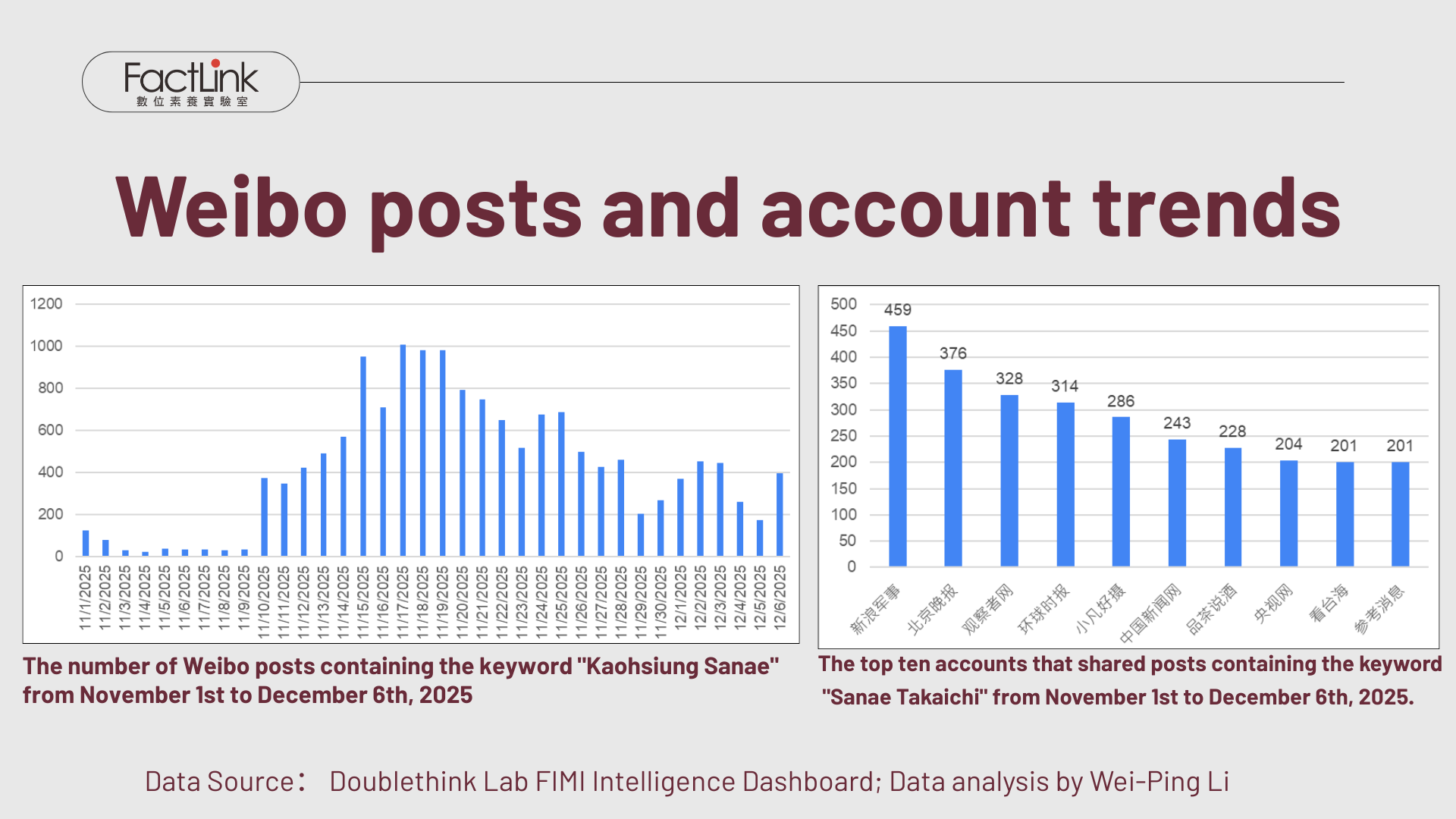
The discussion about Takaichi and her statement reached its peak from November 17 to 19. After that, tensions between China and Japan continued to simmer; this included China’s travel advisory and the cancellation of concerts by Japanese artists. Overall, the volume of discussion started to decline after the peak. Although some Weibo commentary arose from cancellations of Japanese singers’ concerts in late November, it was still much less than the earlier criticism directed at Takaichi.
Most active Weibo accounts discussing Takaichi or her remarks from November 1 to December 6 were dominated by state media outlets such as Beijing Evening News (北京晚报), China News Service (中国新闻网), and Global Times (环球时报). Additionally, China Central Radio and Television (CCTV, 中央电视台)’s main Weibo account and its cross-strait media platform “Looking at the Taiwan Strait” (看台海) ranked among the top ten most active. Guancha.com (观察者网), a platform closely linked to the Chinese government and a strong supporter of official state ideology, also featured prominently. Among politically “Big V” accounts, “Xiaofan Haoshe” (小凡好摄) and “Pincha Shuojiu” (品茶说酒), both known for their nationalist “Little Pink” views, were also among the top 10 accounts amplifying criticism of Takaichi or Japan.
Key Actors: Chinese Diplomats in Japan Struck First on X, State Media and Influencers Amplified
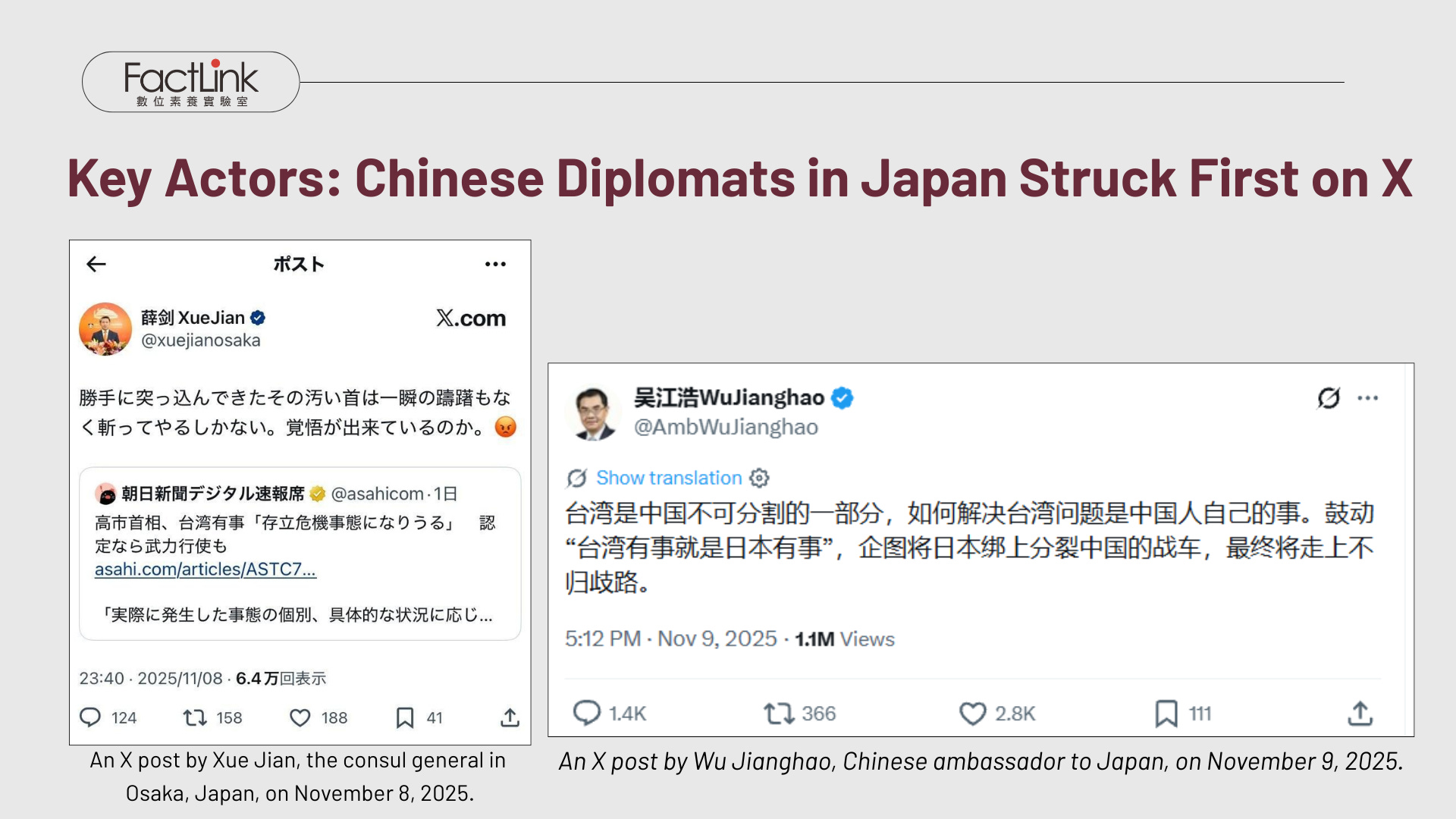
In diplomatic incidents involving Taiwan, initial reactions typically come from diplomats, but the specific actors involved can vary subtly depending on the event’s nature. After Takaichi met Lin Hsin-yi at APEC on November 1, the Chinese Ministry of Foreign Affairs (MFA) was the first to issue a quick protest, with state media outlets such as Beijing Daily, CCTV, and China News Service quickly sharing the MFA’s statement. When Takaichi made the “Taiwan contingency statement” remarks in parliament on November 7, it was Chinese diplomatic officials in Japan who first launched the attack on X. Subsequently, the MFA clarified the official position, followed by state media propaganda, and then “state media-affiliated pseudonymous accounts”13, and influencers mobilized to spread the narratives.
In terms of timing, Consul General in Osaka Xue Jian posted his inflammatory “beheading” statement against Takaichi on X on November 8; on November 9, Chinese Ambassador to Japan Wu Jianghao also posted on X: “Taiwan is an inalienable part of China, and how to resolve the Taiwan question is the Chinese people’s own affair. Agitating for ‘a Taiwan contingency being a Japan contingency’ in an attempt to drag Japan onto the chariot of splitting China, and will ultimately lead to a point of no return.”
Nevertheless, Takaichi’s “Taiwan contingency statement” provoked little response from the Weibo community even after the ambassador’s post. It was only after the MFA’s November 10 press conference clarified the government’s official stance that state media and Weibo users began to strongly condemn and widely share their opinions. Before the MFA framed the issue, while some prominent political Big Vs, like former Global Times editor Hu Xijin and the nationalist influencer “Xiaofan Haoshe,” quickly commented on Takaichi’s remarks the same day, official media outlets remained relatively silent. For example, Beijing Evening News continued to publish stories about Japan’s bear attack issues and Takaichi’s impact on the LDP’s governance as of November 7.
After the MFA established the official stance, central and local state media, along with Weibo Big V accounts, adopted different tones. Central media like CCTV and Xinhua reiterated official messages, such as “Takaichi is making Japan pay the price” and “Takaichi should understand that the Chinese people are not to be provoked.” Meanwhile, local outlets like Beijing Daily, Hong Kong news sites like ifeng.com (鳳凰網), and politically active Big Vs expanded on these narratives by adding emotional language and conspiracy theories, making the messages more dramatic and eye-catching. For example, Posts stating “Takaichi’s remark provokes protests in Japan” were intended to present additional viewpoints or intensify the discussion, while still aligning with the official line, thus making the overall story more comprehensive and sensational.
The role of pseudonymous accounts created by state media outlets is also worth noting. It has been publicly acknowledged that Chinese state media operate such accounts on social media. These pseudonymous accounts give the media more freedom to communicate; for example, they can use pungent or exaggerated language to attract followers and increase influence while maintaining some distance from official accounts when needed.14For instance, “Yuyuan Tantian” was confirmed in 2019 as run by CCTV. During this campaign that criticized Takaichi’s remarks, Yuyuan Tantian acted as an alternative amplifier, fueling patriotic feelings. A notable example occurred on November 18, when Japan’s Director-General of the Asian and Oceanian Affairs Bureau, Masaaki Kanai, met with China’s Liu Jinsong, Director-General of the Asian Department. Without prior Japanese approval, the CCTV released footage of Liu talking to Kanai with his hands in his pockets, implying that Liu was dismissively speaking to Kanai—this footage, posted without Japan’s consent, provoked strong protests in Japan.15CCTV’s pseudo-account, Yuyuan Tantian, posted this footage on Weibo with more provocative language, claiming that Liu’s “May Fourth Youth” style jacket resembled those worn by protesters during the May Fourth Movement a century ago, when demonstrators sought the return of Qingdao from Japan. In essence, the inflammatory rhetoric that CCTV‘s official account could not directly express was instead conveyed through this pseudo-account.16
Misogyny, Historical Grievances, and Geopolitical Competition: A Three-Pronged Propaganda Narrative
The propaganda campaign against Takaichi operated across three concurrent tracks — a misrepresented historical account of World War II, geopolitical rivalry, and misogyny. In terms of tone, the campaign predominantly maintained the two prevailing themes of recent years: firstly, reiterating the disasters and territorial disputes Japan has inflicted upon China; secondly, highlighting the profound relationship between China and Taiwan while accusing Japan of intentionally creating divisions between the peoples on both sides of the strait and even endorsing Taiwanese independence. Furthermore, in response to Takaichi’s election as prime minister and the shifting global political landscape, Chinese propaganda revived issues concerning the sovereignty of the Ryukyu Islands and extended the discussion to include the Philippines within the debates surrounding geopolitical and legal warfare, whilst also incorporating misogynistic attacks targeting Takaichi’s gender identity.
Narrative Theme One: Historical Mobilization Linking the Revival of Militarism with Taiwan Independence
Between November and early December 2025, posts criticizing Takaichi and her statements appeared across various media outlets. Weibo accounts of state-run media such as Beijing Evening News, Global Times, China News Network, and CCTV, along with private outlets like Guancha.cn and several political Big V Weibo accounts, emphasized the theme of “Japan’s militarist ambitions for external expansion.” In these posts, the narrative proposed that Japan once used a “national existential crisis” during World War II as a pretext for invading China. Now, Takaichi once again connected Japan’s claim of existential threat to the Taiwan situation, suggesting that Japan could repeat history. CCTV also noted that the movement of Japan’s Self-Defense Forces toward the southwest signals “right-wing forces’ attempt to intervene in Taiwan Strait affairs through a new form of militarism.” Other posts highlighted her visits to Yasukuni Shrine, efforts to revise the Japanese constitution, and proposals to rename and expand the Self-Defense Forces, all viewed as signs of a militarist resurgence.
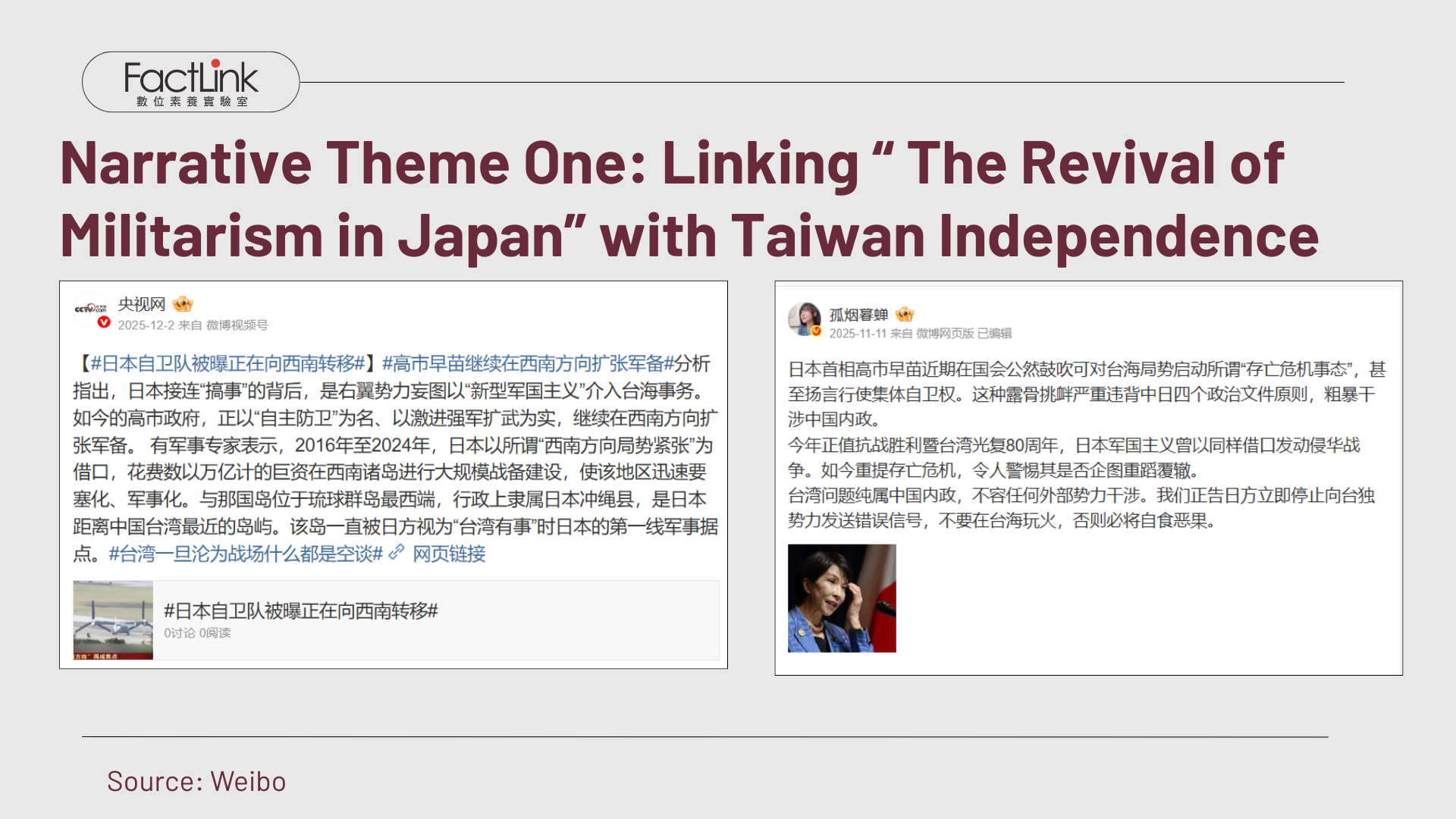
In the CCP discourse, the narrative of “Japanese aggression” and “the return of militarism” is often connected to “Japan encouraging Taiwanese independence.” For example, Gao Zhikai, Deputy Director of the China Center for Globalization, said during an Al Jazeera program in August 2024 that hardcore Taiwan independence supporters are “descendants of Japanese who remained in Taiwan after WWII,” who are fundamentally different from the “true Taiwanese compatriots who share blood ties with China.” Disinformation circulating in the Chinese-language media has also claimed that ‘Taiwanese independence is Japan’s hundred-year conspiracy.17
Takaichi’s Taiwan contingency statement provided Chinese state propaganda and numerous Weibo accounts with a narrative portraying the situation as “Japan and Taiwan independence forces acting in concert.” For instance, the Beijing Daily, citing Xinhua, accused Taiwanese president Lai Ching-te and the DPP of “echoing Takaichi’s remarks and serving as mouthpieces for Japan’s anti-China efforts, seeking to use foreign support to advance independence and potentially escalate Taiwan toward conflict.” Other state media and Big Vs also emphasized that the “Taiwan question” is an internal Chinese matter and warned that Japan should not exploit the alleged crisis as a justification for interference.
In addition to condemning Takaichi’s Taiwan contingency statement as a revival of militarism and an incitement of Taiwanese independence, Chinese state media and Weibo commentators also widely shared quotes from Japanese politicians, Taiwanese commentators, and online influencers. This was meant to create the impression that Takaichi’s statements were not only dangerous but also unpopular both in Japan and Taiwan. For example, multiple state media and influencers’ posts cited that former Japanese Prime Minister Yukio Hatoyama “furiously rebuked” Takaichi with the phrase “the smaller the dog, the louder it barks,” and quoted Taiwanese online celebrity influencer Holger Chen (館長) saying “We Chinese settle our own affairs — Japan should stay out.”
Chinese state propaganda also spread stories claiming that measures taken by the Chinese government in response to Takaichi’s statement had harmed Japan’s economy, sometimes with exaggerated anecdotes, such as widespread cancellations of flights and hotel bookings, as well as significant swings in stock, bond, and currency markets, along with warnings about potential GDP contraction and serious economic risks for Japan.
Narrative Theme Two: Expanding the Geopolitical Battlefield from the Taiwan Strait to Ryukyu and the Philippines
The CCP’s propaganda campaign against Takaichi also highlighted disputes over regional competition in the Indo-Pacific, especially Japan’s sovereignty over the Ryukyu Islands and its collaboration with the Philippines. It portrayed Japan as deliberately subservient to the U.S. and, along with the Philippines, as part of a strategy to counter China and disrupt regional stability. This propaganda campaign was orchestrated by a coordinated network of Chinese diplomats’ X accounts, state media, prominent political Big Vs, and individual Weibo users—who all amplified and shared each other’s content to influence both domestic and international public opinion.
According to a report published in November 2025 by the Australian Strategic Policy Institute (ASPI) and Japan Nexus Intelligence, a Japanese information security research firm, since 2025, the CCP has been increasingly using the accounts of its diplomats and state media on the X platform to strengthen its messaging and fueling division in Japan’s defense cooperation with Southeast Asian countries and Australia in the Indo-Pacific.18These diplomatic and state media posts on X consistently describe Japan’s involvement in international organizations or joint operations as either “the revival of militarism” or “a threat to regional peace,” referencing the historical trauma Japan inflicted on Asian nations during WWII.
Furthermore, the official account of China’s Embassy in Manila characterized the cooperation among the Philippines, Japan, and the United States as a destabilizing influence within the international order of the Asia-Pacific region. For instance, in response to a joint U.S.-Japan military exercise carried out in the Philippines’ Exclusive Economic Zone on August 16, 2025, the CCP’s accounts stated that the Philippines was “inviting wolves into the house and willingly serving as a pawn.”19ASPI and Japan Nexus Intelligence noted that the CCP’s propaganda strategy has shifted away from its previous reliance on covert disinformation operations, toward the use of state media and diplomatic social media accounts to push distorted narratives, a measure that effectively “normalizes” disinformation.
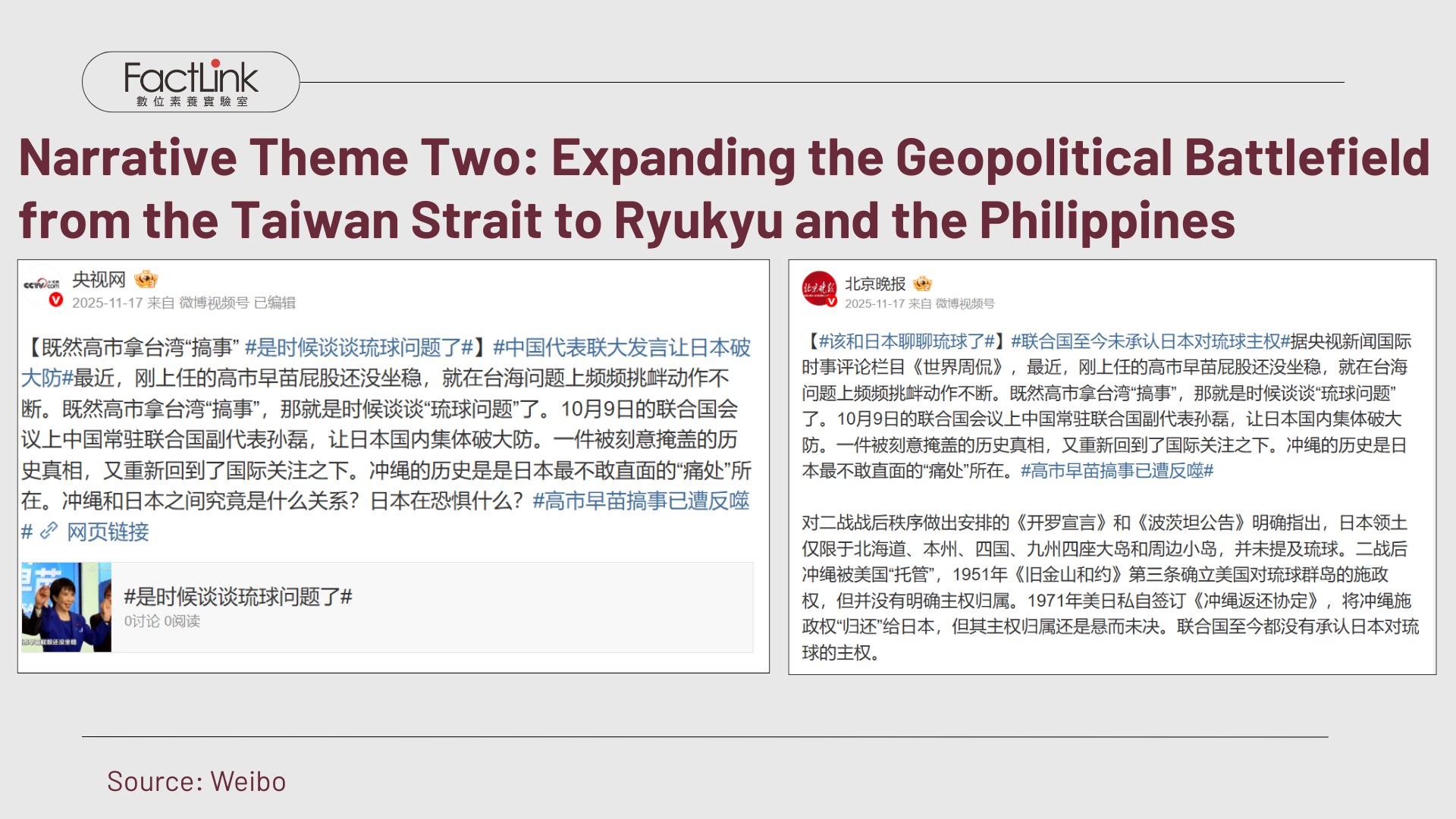
FactLink’s analysis of Weibo post data and Chinese diplomats’ statements on X also shows that the issue of Ryukyu’s status became one of the topics China brought up after Takaichi’s “Japan’s existential matter” remarks. In fact, voices within Chinese academia questioning Japan’s sovereignty over Ryukyu had been growing since the early 2010s.20Recently, Chinese official discourse again referenced Japan’s WWII history, not only revisiting Japan’s colonial rule of Taiwan but also putting more focus on China’s historical ties with Ryukyu and the prejudice and atrocities Japanese militarism inflicted on the Ryukyuan people.21For example, Xue Jian posted in September that “the old militarist Japanese army not only repeatedly carried out massacres and forced expulsions against other countries, but also turned its blade against Ryukyuan civilians during the Battle of Okinawa.”22 After Takaichi’s remark, the CCP brought up the Ryukyu issue as a response to Japan’s support for Taiwan. For instance, CCTV posted: “Since Takaichi is ‘stirring things up’ over Taiwan, #It’s time to discuss the Ryukyu question#.”
Among the 15,241 Weibo posts containing the keyword “Sanae Takaichi” from November 1 to December 6, 454 mentioned Japan’s sovereignty over Ryukyu and the grievances of Ryukyuan leaders and residents toward Japan. State media outlets, including Beijing Daily, Beijing Evening News, and Global Times, highlighted the historical fact that Ryukyu was once a tributary state of China before being illegally occupied by Japan. They also pointed out that while Ryukyu was placed under U.S. trusteeship after WWII, its sovereignty was never officially resolved and should be decided by Ryukyuan self-determination. These official narratives on Weibo continued the decade-long “undetermined sovereignty of Ryukyu” argument, citing the Cairo Declaration and the Potsdam Proclamation as evidence that Ryukyu was never incorporated into Japanese territory, and asserted that subsequent international agreements such as the San Francisco Peace Treaty or the U.S.-Japan Agreement on the Reversion of Okinawa failed to settle the question of Ryukyuan sovereignty.
These posts also highlighted the anxiety of Ryukyuan anti-war activists about Japan’s potential involvement in a Taiwan Strait conflict, since any U.S. military intervention and participation by the Japan Self-Defense Forces would put Ryukyu on the front line of battle.23 Overall, in the CCP narrative, Ryukyu is shown as a victim caught between the U.S.-Japan military alliance and China’s geopolitical red lines, with local residents strongly opposed to becoming pawns in a geopolitical conflict.
Regarding the Philippines, which has had multiple sea clashes with China in recent years, it initially drew little attention after Takaichi’s Taiwan contingency statement. However, following Kyodo News‘s report on November 30 that the Japanese government was considering exporting missiles to the Philippines, Chinese state media, propaganda outlets like Guancha.cn, and prominent online influencers launched attacks on Japan-Philippines relations. They framed it as “the Philippines colluding with Takaichi against China” and “Japan’s expansionist ambitions being carried out through the Philippines,” portraying it as additional evidence of Japan’s attempt to overturn the post-WWII order.24
Narrative Theme Three: Misogynistic Attacks Targeting Sanae Takaichi
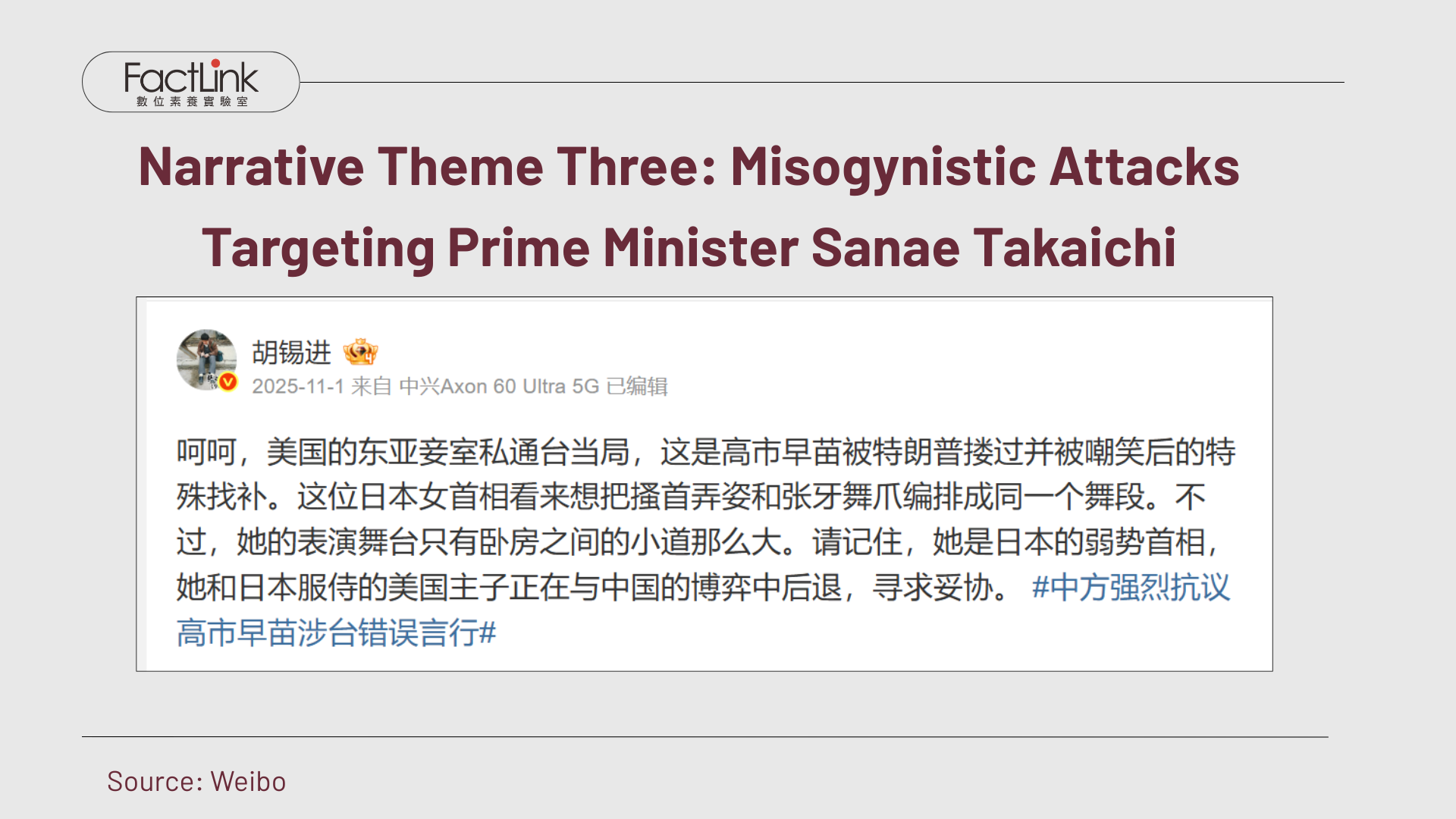
One of the key features of the CCP’s propaganda against Takaichi and her remark is the relentless scrutiny of her actions as a woman, particularly during her meetings with foreign leaders. Commentators directed highly sexist criticisms at her, even framing Japan’s interactions with Western nations through a similar sexist lens.
Most of these sexist attacks were launched by political Big Vs and individual Weibo accounts. For instance, Hu Xijin, the former editor-in-chief of Global Times, criticized Takaichi’s meeting with Lin Hsin-yi at APEC on November 1 by leveraging her gender, calling her and Japan America’s “East Asian concubine” and suggesting they secretly liaise with Taiwan.25 In addition, other Weibo users employed phrases such as “extreme subservience,” “fawning on America,” and “indecorous” to describe Japan’s ties with the U.S. Takaichi’s diplomatic gestures toward other world leaders, which were courteous, were amplified and interpreted as flirtations or affectations. A pro-China Taiwanese online personality also coined “mama-san diplomacy” to describe her diplomatic style. (In Japan and East Asia, “mama-san” is usually referred to as a woman in charge of a geisha house or bar). This term was further adopted by propaganda websites targeting Taiwan, such as “Taiwan Strait Network,” which compiled videos of Takaichi meeting various leaders. The phrase quickly rose to become a trending search term on Weibo.26
Conclusion: A Full Picture of China’s Information Operations Targeting Japan
This report, based on X and Weibo posts containing the keyword “Sanae Takaichi” (the name of Japan’s Prime Minister) from November 1 to December 6, 2025, analyzes the actors on Weibo and the related narratives during this period. It shows how Chinese diplomats, state media, and prominent online political influencers (Big Vs) repeatedly launched a propaganda campaign targeting Japan’s new prime minister and her position on Japan’s relations with Taiwan.
Research data indicate that when Takaichi made her Taiwan contingency statement, Chinese diplomats in Japan were the first to attack the X platform. Meanwhile, Weibo influencers responded sporadically, awaiting the Ministry of Foreign Affairs to clarify the official stance. Once announced, state media and online influencers together launched a new wave of propaganda, each fulfilling specific roles within their narratives.
The propaganda campaign reinforced familiar themes, such as the revival of militarism and links to Taiwanese independence. It also emphasized Ryukyu’s sovereignty issue, criticized Japan-Philippines relations, and attacked Takaichi’s personal reputation. Following Takaichi’s election, political influencers’ commentary on her image was notably tinged with explicit misogyny.
The CCP’s repetitive narratives in response to Sanae Takaichi’s “Taiwan contingency” statement are not an isolated information campaign and should be viewed through a recurring “narrative playbook.” Moving forward, we expect the CCP’s propaganda related to events involving Japan will continue emphasizing the connection between Japanese militarism and Taiwanese independence, portraying Japan’s support for Taiwan as evidence of a resurgence in militarism. It is also important to closely watch the CCP’s international propaganda concerning the Ryukyu narrative.
"V" stands for "verified," a term that later came to describe social media accounts with many followers. See 微博大V - China Digital Space. (n.d.). https://chinadigitaltimes.net/space/%E5%BE%AE%E5%8D%9A%E5%A4%A7V
BBC News 中文. (2025, August 15). 《南京照相館》與《731》:兩部抗戰電影如何重塑中國的創傷歷史記憶? https://www.bbc.com/zhongwen/articles/cy4d0g4q07po/trad.
“外交部:中方设立台湾光复纪念日有力巩固世界上只有一个中国的国际共识-新华网,” n.d., https://www.news.cn/world/20251027/93666aafe02c49348389263c16b68aab/c.html.?
中央通訊社. (2025, November 15). 高市早苗「台灣有事」說引發日中緊張 事件脈絡一篇看懂. 中央社 CNA. https://www.cna.com.tw/news/aopl/202511140305.aspx
民視新聞網. (2025, November 2). APEC高市早苗見林信義連發2文 中國跳腳轟違反一中. Yahoo News.
中央通訊社. (2025, November 15). 高市早苗「台灣有事」說引發日中緊張 事件脈絡一篇看懂. 中央社 CNA. https://www.cna.com.tw/news/aopl/202511140305.aspx.
安德烈, “中國外交官斬首論為何驚爆日本輿論,” RFI - 法國國際廣播電台, November 10, 2025, https://www.rfi.fr/tw/%E4%B8%AD%E5%9C%8B/20251110-%E4%B8%AD%E5%9C%8B%E5%A4%96%E4%BA%A4%E5%AE%98%E6%96%AC%E9%A6%96%E8%AB%96%E7%82%BA%E4%BD%95%E9%A9%9A%E7%88%86%E6%97%A5%E6%9C%AC%E8%BC%BF%E8%AB%96.
中央通訊社. (2025, November 16). 中國海事局:17至19日連3天黃海部分海域實彈射擊. 中央社 CNA. https://www.cna.com.tw/news/acn/202511150131.aspx
北京懲罰日本,為何拿流行明星「開刀」? (2025, December 8). 紐約時報中文網. https://cn.nytimes.com/china/20251208/china-japan-anime-taiwan-dispute/zh-hant/
Li, M. (2024). A cross-platform comparison of China’s confrontational diplomatic communication. Journal of International Communication, 30(2), 372–393. https://doi.org/10.1080/13216597.2024.2335960
DiResta, R., & Goldstein, J. A. (2025). Full-Spectrum Propaganda in the Social Media Era. Security Studies, 34(4), 714-750.
Japan has the second-largest number of X platform users after the United States.。Statista. (2025, November 19). X/Twitter: Countries with the largest audience 2025. https://www.statista.com/statistics/242606/number-of-active-twitter-users-in-selected-countries/?srsltid=AfmBOoryE8ecsTnb6eOxaDPhtoifEa342Adp9H_tLGSN_9Zrl6SGyGcP
Some Chinese state media outlets create pseudonymous accounts on Weibo to conceal their official media identity, leading people to mistakenly believe they are personal accounts. Some accounts have openly revealed their official media identity, such as CCTV’s “Yu Yuan Tan Tian.” However, some accounts still provoke speculation. Please see the discussion below.
BBC News 中文. (2019, August 21). 中美貿易戰和香港抗議中的「神秘博主」是誰. https://www.bbc.com/zhongwen/trad/chinese-news-49404109
戴雅真. (2025, November 19). 中國司長手插口袋疑似擺拍 日本抗議媒體拍攝未事前協調. 中央社 CNA. https://www.cna.com.tw/news/aopl/202511190143.aspx
BBC News 中文. (2019, August 21). 中美貿易戰和香港抗議中的「神秘博主」是誰. https://www.bbc.com/zhongwen/trad/chinese-news-49404109
【錯誤】網傳「戰後有30萬日本人留在台灣」、「目前台灣有10%日裔人口」? (2024, September 14). 台灣事實查核中心. https://tfc-taiwan.org.tw/fact-check-reports/migration-10951/
ASPI Staff & Japan Nexus Intelligence. (2025, November 28). Normalising disinformation: China shifts to overt operations against Japan. The Strategist. https://www.aspistrategist.org.au/normalising-disinformation-china-shifts-to-overt-operations-against-japan/
央視網. (2024, August 16). 国防部:美日唯恐南海不乱 兴风作浪. https://news.cctv.com/2024/08/16/ARTIjqvDnsZ88D9rB0qNQcVc240816.shtml?spm=C94212.P4YnMod9m2uD.ENPMkWvfnaiV.88
Reporter, G. S. (2013, May 14). Chinese academics in call to review Japanese sovereignty over Okinawa. The Guardian. https://www.theguardian.com/world/2013/may/14/china-japan-okinawa-sovereignty-ryukyu
中央通訊社. (2025, November 16). 反擊日本 中國輿論掀「琉球地位未定論」. 中央社 CNA. https://www.cna.com.tw/news/acn/202511160070.aspx.
薛剑XUEJian on X: “他国民に対し虐殺や強制連行を重ねるだけでなく、沖縄戦で琉球の一般市民にも牙をむく軍国主義の旧日本軍。「自国の兵隊が敵よりも残酷」、これこそ80年後に振り返る所謂「大東亜共栄」の真実! Https://t.co/QMH8QU1jC7” / X. (n.d.). X (Formerly Twitter).
For example, https://m.weibo.cn/detail/5233573759292671.
For example, https://m.weibo.cn/detail/5239156957776265.
See https://m.weibo.cn/detail/5228317158413234.
See https://www.douyin.com/video/7569141990076550435.